
English version machine-translated from the Vietnamese original — under review.
I. Questions and answers:
What is the main purpose of a fire damper in an HVAC system?
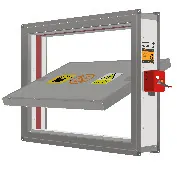
- The main purpose of a fire damper is to maintain compartmentation at fire-resisting boundaries and to protect escape routes in the event of a fire. It works by closing automatically to prevent fire and hot gases from spreading through the ductwork of the HVAC system.
What is the difference between insulated and non-insulated fire dampers?
- An insulated fire damper meets both the integrity (E) and insulation (I) criteria for the intended fire resistance period, creating a barrier against both fire and heat transfer. A non-insulated damper, by contrast, meets only the integrity criterion and provides no significant insulation.
According to BS EN ISO 25925-1:2018, what is the main objective of fire resistance testing of fire dampers?
- According to BS EN ISO 25925-1:2018, the main objective of fire resistance testing is to evaluate the ability of a fire damper to prevent the spread of fire for a specified period under defined conditions.
What is the significance of the "S" classification in the context of fire dampers?
- The "S" classification relates to smoke leakage limits. A fire damper with an "S" classification has been tested and shown to be capable of limiting smoke leakage at ambient temperature.
Briefly describe the purpose of the salt spray test for the thermal release mechanism.
- The salt spray test helps evaluate the performance of the thermal release mechanism after exposure to harsh environmental conditions such as corrosion. It ensures that the mechanism operates reliably even after dirt and dust have accumulated.
What are the conditioning requirements for water-based SEALING materials used with fire dampers?
- Water-based materials used to seal gaps ≤ 10 mm must be conditioned for at least 7 days before testing. For larger gaps (>10 mm), conditioning for at least 28 days is required.
How does the way a fire damper is installed during testing relate to its field of application?
- The installation orientation during testing is very important because it determines the damper's performance in different applications. Test results apply only to dampers of the same type and in the same installation position as tested.
What role does the connecting duct play in fire resistance testing of fire dampers?
- The connecting duct simulates the actual system in which the fire damper will be installed. It affects the airflow and pressure conditions throughout the test.
What are some of the key measurements taken in fire resistance testing of fire dampers?
- Key measurements in the test include: furnace temperature, damper temperature, pressure difference, and gas leakage rate.
According to TCVN, what steps must be taken if a fire damper does not close within 2 minutes of the start of the fire test?
According to TCVN, if a fire damper does not close within 2 minutes of the start of the fire test, the test must be stopped, as this indicates a failure of the release mechanism.
Key terms
- Fire damper: A device installed in HVAC ductwork that closes automatically when high temperature is detected, to prevent fire and smoke from spreading.
- Integrity (E): The ability to prevent the spread of fire and hot gases in the event of a fire.
- Insulation (I): The ability to limit heat transfer, preventing an excessive temperature rise on the unexposed side.
- Leakage classification (S): The limit on air or smoke leakage through a closed damper.
- Thermal release mechanism: The component that senses temperature and triggers the damper to close automatically.
- Supporting construction: The wall, floor or structure in which the damper is installed for the test.
- Connecting duct: The duct attached to the damper during the test, simulating actual installation conditions.
- Fire resistance: The ability of a component to withstand fire temperatures for a specified period.
- Test specimen: The fire damper, together with its associated components, being tested.
- Field of application: The damper sizes, configurations and installation conditions to which the test results can be applied.
- Actuating mechanism: The component directly linked to the damper that changes its position from "open" to "closed".
- Measuring station: The system that measures the gas flow through the damper during the fire test.
Timeline of key events:
- 1996: Standard BS ISO 10294-1:1996 (Fire-resistance tests — Fire dampers for air distribution systems — Part 1: Test method) was first published.
- 1999: EN 1366-2:1999 (Fire resistance tests for service installations - Part 2: Fire dampers) became the current standard. At the same time, BS ISO 10294-2:1999 and BS ISO 10294-3:1999 remained in force.
- 15 May 1997: Standard BS ISO 10294-1:1996 came into effect in the United Kingdom.
- 2014: Amendment 1 to BS ISO 10294-1:1996 (+A1:2014) was applied, with changes to subclause 6.3 and the addition of Annex A. Standards BS ISO 10294-4:2001 (+A1:2014) and other amendments remained in force.
- June 2015: Standard EN 1366-2:2015 was approved by CEN, replacing EN 1366-2:1999. In the UK, this standard was implemented as BS EN 1366-2:2015, replacing the old standard.
- 2017: Standards TCVN ...-1:2017 (equivalent to ISO 10294-1:1996) and TCVN ...-2:2017 (equivalent to ISO 10294-2:1999) were published in Vietnam, establishing the benchmark for the testing and classification of fire dampers.
- 2018: Standard BS ISO 21925-1:2018 (Fire resistance tests — Mechanical fire dampers for air distribution systems — Part 1) was published, replacing the old standards BS ISO 10294-1:1996 + A1:2014, BS ISO 10294-2:1999, BS ISO 10294-3:1999, and BS ISO 10294-4:2001 + A1:2014.
- 31 January 2015: Implementation of ISO amendment 1:2014, with changes to subclause 6.3 and the addition of Annex A.
List of organizations and their roles:
- BSI (British Standards Institution): The UK's national standards body, responsible for preparing and publishing British standards, including fire resistance test standards. BSI also manages the adoption of European and international standards in the UK.
- CEN (European Committee for Standardization): The European standards organization that develops EN standards, such as EN 1366-2.
- CENELEC: The European organization for electrotechnical standardization, working alongside CEN.
- ISO (International Organization for Standardization): The international standardization body that develops standards such as ISO 10294 and ISO 21925, relating to fire dampers.
- Technical Committee FSH/22/-/4 (UK): Responsible for drafting fire resistance test standards for dampers, sealing materials and smoke extraction systems.
- European Commission and European Free Trade Association: Mandated CEN to prepare the EN 1366 standard.
- Directorate for Standards, Metrology and Quality (Vietnam): Oversees the implementation of standards.
- Ministry of Science and Technology (Vietnam): Announces new standards.
- Ministry of Construction (Vietnam): Proposes and enforces related standards.
- Vietnam Institute for Building Materials - Ministry of Construction: Drafts and revises construction standards.