
English version machine-translated from the Vietnamese original — under review.
What is Minimum Operating Pressure (MOP)?
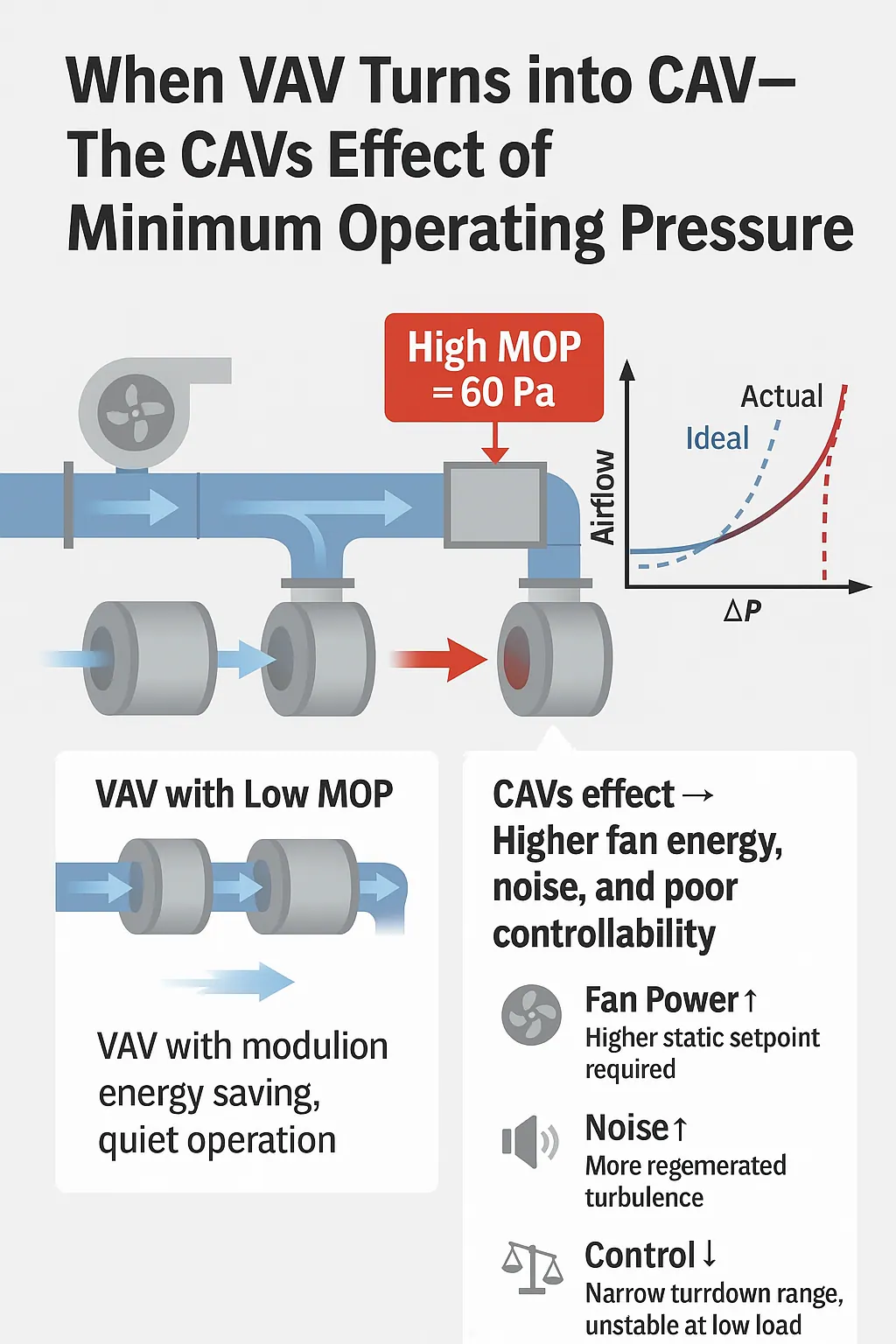
- It is the minimum differential pressure across the VAV box required for the airflow sensor (usually a pitot cross/venturi, sometimes hot-wire) and the controller to measure & control accurately.
- With differential-pressure type sensors: Q=K . If ΔP<MOP, the signal is weak → the airflow reading is wrong → the damper “hunts” and cannot hold the setpoint.
How does MOP affect operation?
- Ability to hold airflow at low load
- The lower a system's duct static reset, the more energy it saves. But a VAV box with a high MOP will drop out of control early as the static pressure falls → airflow drops, Vmin is not maintained, and the air distribution becomes unbalanced.
- Fan energy & duct pressure setpoint
- A high MOP forces the system static pressure setpoint to be higher to “feed” that box → increasing fan power for all the remaining boxes.
- Regenerated noise & vibration
- For the same airflow, a larger ΔP\Delta PΔP across the box → higher local velocity & turbulence → increased regenerated noise from the box/duct.
- Control range (turndown) & accuracy
- A high MOP narrows the usable control range at low pressure. In terms of operating feel: it is difficult to hold ±5% of setpoint when the system runs quietly (low static at night/in mid-season).
- Knock-on effect on size selection
- To compensate for a high MOP, it is sometimes necessary to select a larger size (lower velocity, lower required ΔP\Delta PΔP) → increased size/cost.
“For the same airflow, one manufacturer's MOP is double/triple another's” – what does that lead to?
Assume the same Q = 250 L/s (0.25 m³/s):
| Manufacturer | MOP (Pa) | Main operating consequence |
|---|---|---|
| A | 20 | Runs easily at low static, saves fan energy, lower noise |
| B | 40 | Requires higher system static ≈ +20 Pa |
| C | 60 | Requires higher system static ≈ +40 Pa; prone to losing control when the pressure is reset low |
Consequences for fan power (relative, ignoring efficiency for simplicity)
Fan power is proportional to P **=**Q×ΔP. Comparing only the box's minimum pressure portion:
- Manufacturer A: 0.25×20=50.25×20=5 (relative units)
- Manufacturer B: 0.25×40== 100.25×40=10 → ≈ double A
- Manufacturer C: 0.25×60= 150.25×60=15 → ≈ triple A
In practice, a box with a high MOP pushes up the duct static setpoint of the whole system; the remaining boxes must close further to “burn off pressure”, causing noise + losses across the board.
Why does MOP differ between manufacturers?
- Sensor sensitivity & geometry (K-factor, number of pitot holes, venturi).
- Controller calibration (accuracy at low ΔP.
- Inlet conditions (elbow/tee close to the inlet, insufficient straight run; with/without an integrated diffuser/straightener).
- Noise-reduction design & box casing (long attenuated boxes usually allow lower velocity → “achieve Q” at a lower ΔP).
How to decide when selecting/comparing
- Prioritise a low MOP (under the same test conditions) to:
- Lower the duct static setpoint, reduce fan energy, reduce noise, and widen the control range at low load.
- Compare under the same conditions:
- Same size, same inlet straight run (≥ 1D–3D or with a flow straightener), same control algorithm, same rating standard (e.g. conditions per AHRI 880).
- Check the operating range:
- The manufacturer should state the accuracy (±%) when ΔP ≥ MOP and the turndown (e.g. 10:1).
- Solutions if the MOP of the preferred option is somewhat high:
- Increase the box size (lower velocity → lower ΔP to achieve Q).
- Improve the inlet arrangement (straight run, turning vanes) or use a flow straightener.
- Choose a sensor/board sensitive to low pressure (0–250 Pa range with good resolution).
- Set the static reset based on the “worst box” with feedback, then re-optimise with a trim & respond strategy so the whole system is not driven too high.
Brief conclusion
- The lower the MOP → the quieter, more economical and more stable the system at low load.
- If two manufacturers give the same Q but the MOP differs by 2–3 times, the high-MOP manufacturer will:
- Require higher system static pressure,
- Increase fan power consumption accordingly,
- Be prone to noise and have a narrow control range when the system runs in economy mode.