
English version machine-translated from the Vietnamese original — under review.
This document consists of excerpts from an AMCA International webinar entitled "VAV Systems Part 2: VAV System Duct Design", presented by Lisa Cherney and Steve Taylor. The purpose of the webinar is to introduce optimised techniques for designing high-performance VAV (Variable Air Volume) systems at minimum cost, covering topics such as VAV main duct sizing, VAV box sizing and return air system design. The document discusses different duct design methodologies, such as the newer Reducing Friction Rate method, as well as specific recommendations to minimise pressure losses and optimise life cycle cost for HVAC system components. To qualify for PDH credits, participants are required to attend the entire session and complete a post-webinar assessment.
4 Game-Changing VAV System Design Tips: What the Experts Want You to Know
Introduction: Overview
The HVAC (heating, ventilation and air conditioning) system is often the invisible yet extremely complex heart of a modern building. Although many standard design methods are widely applied, the most impactful improvements often come from challenging conventional rules. This article reveals four expert-level design tips, distilled from leading industry research, that can significantly improve performance, reduce costs and simplify the entire design and construction process.
1. Specify One Line, Gain a Hundred Benefits: The Power of ASHRAE Guideline 36
Traditionally, engineers have had to spend countless hours writing detailed sequences of operation (SOO) for building control systems, a task that can lead to errors and inconsistencies.
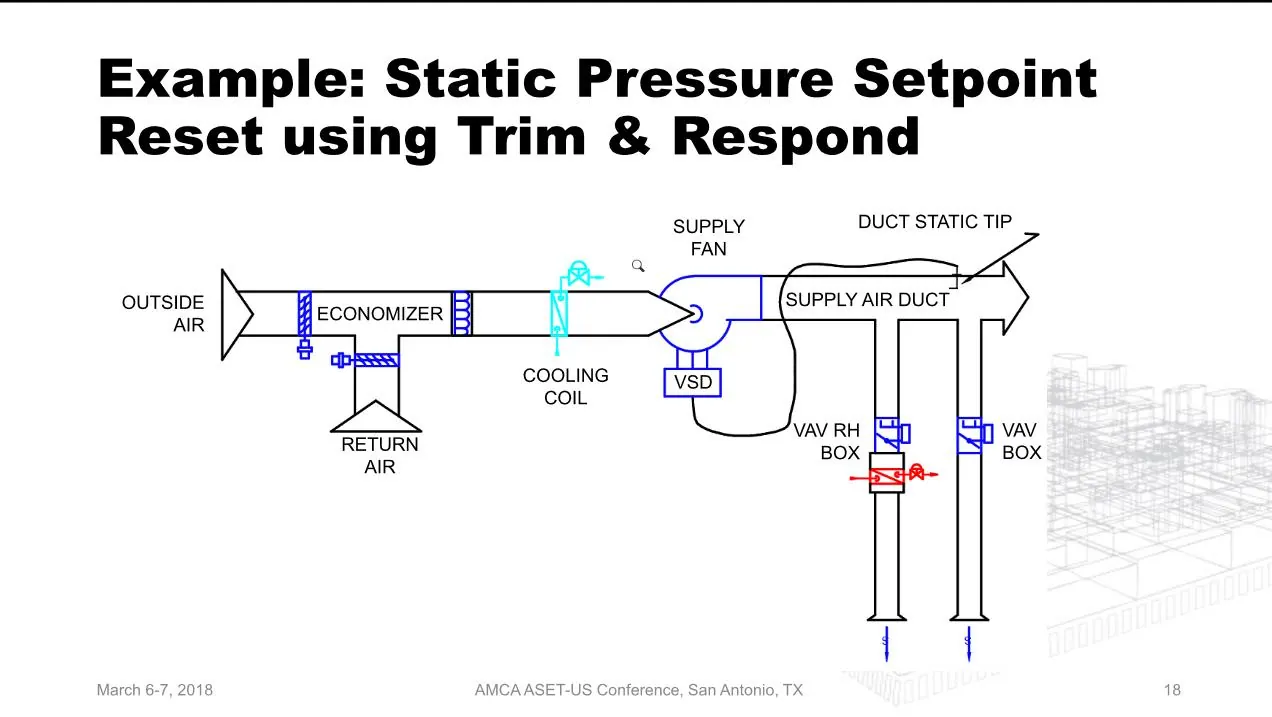
ASHRAE Guideline 36 arrived as a revolutionary solution. The aim of this guideline is for the industry's leading experts to create and maintain advanced sequences of operation. This shifts the burden of writing and debugging complex control sequences from the design engineer to the manufacturers, who can pre-program and thoroughly test these sequences at scale.
For the design engineer, the work is simplified remarkably. Instead of writing pages of documentation, they only need to specify a single line: "Use sequences of operation per ASHRAE Guideline 36".
This is not a theoretical concept. Guideline 36 is a practical, industry-supported solution that engineers can specify right away—at least five major manufacturers have already pre-programmed these sequences of operation. Its adoption benefits all stakeholders:
- Lower first cost for the whole design/construction team: Reduced design, programming and testing time.
- Lower maintenance cost and easier maintenance: The sequences of operation are standardised and thoroughly tested, making diagnosis and troubleshooting easier.
- Lower energy cost and improved performance: These sequences of operation are optimised for maximum energy efficiency.
This is perhaps the most important tip for streamlining the entire process, ensuring high performance with minimal effort.
2. VAV Box Minimum Airflow: Don't Trust the Catalogue, Trust the Data
It is common practice for engineers to set VAV box minimum airflow based on the manufacturer's catalogue, which typically recommends conservatively high values (e.g. 20-30% of design airflow) on the grounds of ensuring controllability.
However, data and current standards show that this practice is not only outdated but also seriously wasteful of energy. Recent research and updated standards (such as ASHRAE 90.1-2019) not only allow but require the minimum airflow to be set equal to the minimum required ventilation airflow.
The expert view on this issue is very clear:
"VAV manufacturers' data is often inaccurate and can be ignored."
The reason is simple. First, research (such as RP-1515) shows that actual loads in buildings are usually very low and that, in practice, VAV boxes are often more than 3 times larger than necessary. Maintaining a high minimum airflow wastes a significant amount of fan energy and heating energy. Second, modern VAV controllers are highly accurate even at extremely low velocity pressure (VP) (down to ~0.003" VP), making low minimum setpoints entirely feasible and controllable.
Where the minimum ventilation airflow is lower than the controllable level, Guideline 36 automatically uses Time-Averaged Ventilation (TAV) mode. This mode cycles the airflow between zero and the minimum controllable level over a short period (e.g. 15 minutes) to achieve the required average ventilation rate. This completely debunks the myth of "controllability" at low airflow.
To apply this, engineers should include the following two simple technical specifications in their designs:
- Specify BAS VAV controllers with a minimum velocity pressure of VP ≤ 0.004”.
- Specify a VAV airflow sensor amplification factor of F ≥ 2.
3. Fan Arrays: A More Efficient Solution for "Giant" AHUs
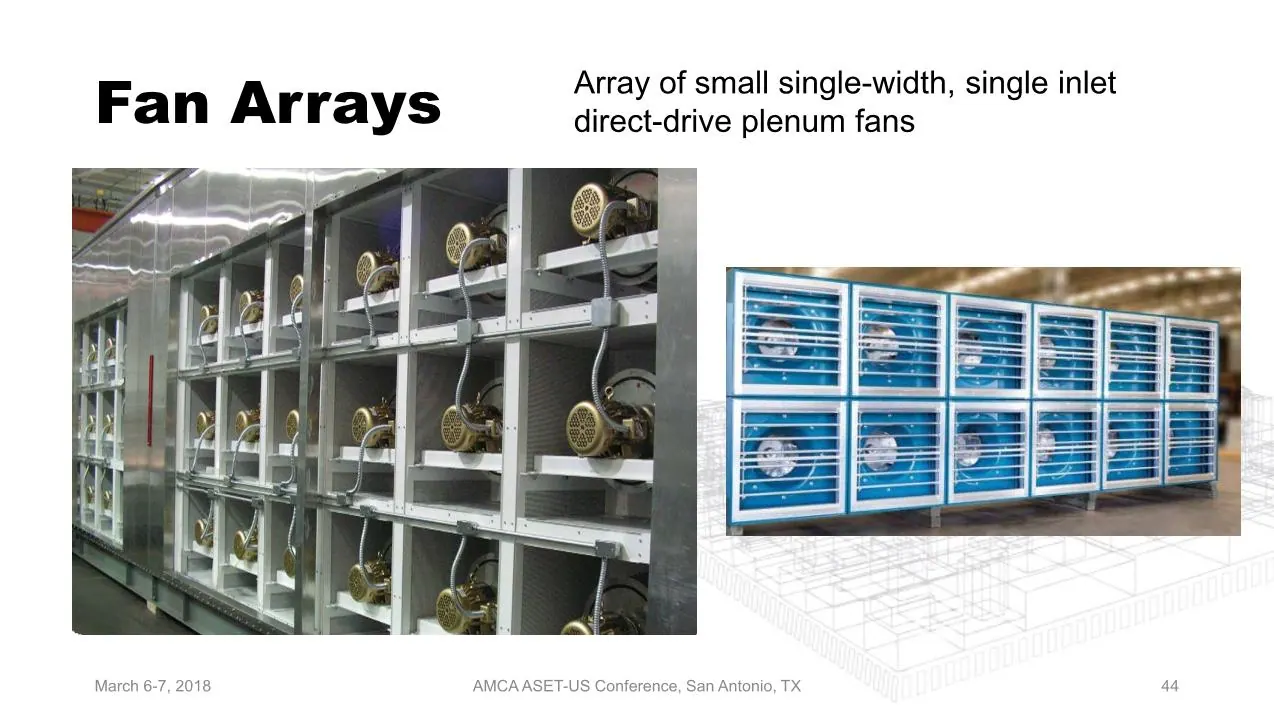
A fan array is a cluster of several smaller, direct-drive plenum fans used to replace a single large fan in an air handling unit (AHU). This solution offers many outstanding advantages:
- Shorter AHU length: Saves plant room space.
- Lower noise level: Runs more quietly than a single large fan.
- Improved redundancy: If one fan fails, the remaining fans can continue to operate.
- Lower fan energy: Higher overall efficiency, especially when silencers or system effects are eliminated.
- Easier replacement and installation: Smaller, lighter motors and fans are easier to handle.
The most impactful benefit of fan arrays is that they enable the use of very large "Mega AHUs" (up to 200,000 cfm or more). For large buildings, using one Mega AHU instead of several smaller AHUs significantly reduces first cost, requires less space and saves more energy.
Although potential challenges such as "rogue zones" may exist, they can easily be managed with modern control systems, such as the diagnostic sequences included in ASHRAE Guideline 36. This makes fan arrays a powerful solution with virtually no drawbacks, making them a superior choice for modern VAV systems.
4. Return Air Systems: Why a Return Plenum Is Better Than a Fully Ducted System
When designing a return air system, there are two main options: use a fully ducted system or use the space above the suspended ceiling as a return air plenum. Although some believe that a ducted system is better, using a ceiling plenum offers significant benefits that are often overlooked.
Below are the outstanding advantages of using a ceiling return air plenum:
- Significant cost reduction: Reduces the cost of the HVAC system (by $3 to $5/ft²) as well as the cost of other trades thanks to less congestion in the ceiling space.
- Energy savings: Reduces fan energy cost by about 20% thanks to lower system pressure losses. Moreover, it allows the use of relief fans or fanless relief systems in systems with an outdoor air economizer, which is more efficient than return fans.
- No balancing required: The system incurs almost no balancing cost and self-balances better as airflow changes.
- Lower noise: Reduces sound transmission between rooms compared with ductwork without an acoustic lining.
A common concern is indoor air quality (IAQ) or humidity problems. However, these problems can be prevented completely by ensuring that the return plenum is designed to maintain positive pressure relative to the outside.
In addition, claims that ducted return systems are better at reducing the spread of COVID are not supported by research. A study by Bahnfleth et al. shows that a return plenum can actually dilute contaminants better.
Conclusion: Thinking Outside the Box
This article has shown that the most advanced and efficient HVAC designs often come from questioning established norms and applying new, data-driven methods. These four tips — using Guideline 36, setting VAV minimum airflow correctly, using fan arrays and taking advantage of return plenums — are not just minor tweaks but fundamental changes in design philosophy. They help create systems that perform better, cost less and are more sustainable.
So, which other design 'rules' in your industry are waiting to be challenged and improved?