
English version machine-translated from the Vietnamese original — under review.
JOHN KNAPP - Vice President, Air Control Solutions, Ruskin Grandview, Mo.
THE IMPORTANT DIFFERENCES BETWEEN FIRE DAMPERS AND SMOKE DAMPERS
The most effective fire protection design must include the functions of detecting, suppressing and containing fire, both active and passive. Active fire protection (and firefighting) includes all systems designed to suppress or extinguish fire when fire is present, as well as to support the protection of people. These systems include smoke detection, pressurisation, fire alarms, sprinklers, exit signs and evacuation plans. However, active fire protection systems do not prevent the spread of smoke and toxic gases, which are the leading cause of death. Passive fire protection is designed to prevent the spread of smoke, toxic gases and fire. By compartmentalising fire (fire compartments), passive fire protection systems can:
- Increase the effectiveness of active fire protection systems
-Create favourable conditions for the evacuation of people
Protect property
Minimise damage
Compartmentalising a building with rated fire-resistant elements such as fire walls, fire barriers, fire partitions, smoke barriers and smoke partitions is an important feature. When ventilation ducts, heating ducts or air conditioning (HVAC) ducts run through these elements, the integrity of the system in terms of fire rating must be maintained by using fire dampers, smoke dampers or combination fire/smoke dampers at the locations where the ducts penetrate the walls. These three types of dampers have different operating functions and are installed and maintained differently. Knowledge of these differences determines the correct application of each damper and its operation within the fire safety system.
Under the international standards adopted by Vietnam as specified in QCVN 03:2021/BCA, there are 2 types of dampers, translated as FIRE DAMPERS (fire valves) and SMOKE CONTROL DAMPERS (smoke dampers). These 2 types of dampers comply with different test standards and different evaluation conditions. A combination fire/smoke damper is a fire damper that must also meet an air leakage criterion during fire of <200 m3/h/m2. (EIS damper).
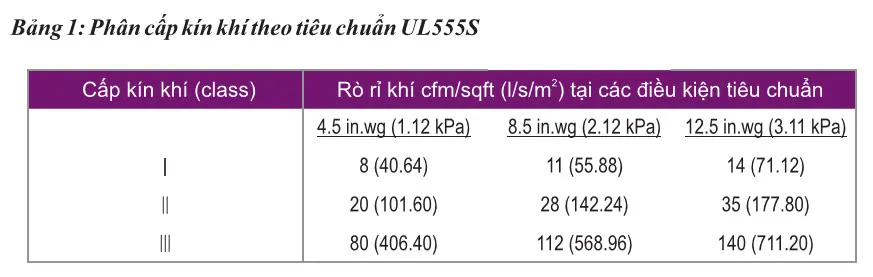
A fire damper (also called a fire-stop damper, fire barrier damper...) is a normally open damper that closes once when the temperature in the duct reaches its critical level, by means of a fusible link or a fire alarm signal from the control centre. A smoke damper (also called a smoke control damper) is a normally closed damper that opens when smoke is present and closes again when the critical temperature is reached or on a fire alarm signal. A combination fire/smoke damper is a normally open fire damper that closes on critical heat or on a fire alarm signal from the control centre to prevent the spread of fire while also blocking smoke (S condition). The codes require, and engineers agree, that the best way to compartmentalise fire is to use combination fire/smoke dampers. A combination damper not only closes on high temperature in the duct but can also close when smoke is detected. A combination damper can also override normal control to pressurise particular spaces. This damper carries a leakage rating meeting smoke control standards per UL555S or BS-EN 12101-8:2011, and test standard BS-EN 1366-10:2011 as required by QCVN 03:2021/BCA, to block smoke along whatever paths it finds - this is the main difference from a fire damper. Only combination fire/smoke dampers and smoke dampers are leakage-rated devices (as in table 1 below)
FIRE SPREAD PREVENTION DAMPERS (FIRE DAMPERS) A fire damper can be defined as "a device installed in the ducts and (open) air transfer openings of an air distribution system or smoke control system, designed to close automatically upon detection of heat. It is also used to interrupt the airflow in order to prevent the spread of fire and maintain the integrity of the rated compartment" 1. The primary function of the damper is to prevent fire from passing from one side (boundary) of a compartment to the other. Fire dampers (figure 1) are operated by a fusible device, mostly of the fusible link type, or are closed under the control of an electric motor with a spring-return function. Fire dampers are designed and tested to UL 555: Standard for Safety for Fire Dampers, or ISO 10294-1-2-4 :1996 in accordance with technical regulation QCVN 03:2021/BCA to ensure integrity with fire compartments. Fire dampers are fitted with a fusible link (rated 165OF to 286OF / 74OC to 141OC) that holds the damper blades open until the link melts. Depending on the melting limit (fusing rating), the blades will then close and prevent fire from entering the adjacent compartment.
Installation location: Fire dampers are installed within or close to the wall or floor at the point where the duct penetrates, to ensure the integrity and fire resistance rating of the wall or floor, regardless of whether it applies to a duct or an open return air box. If the ductwork collapses (due to fire), the fire dampers must still remain attached to the wall or floor. A fire damper can be considered part of the fire-rated wall system.
Sleeves and accessories: All fire dampers are required to be installed in sleeves (sleeve - damper body). Thin sleeves (18-20 ga./0.9-1.2 mm) must be connected to the duct with clip flanges (S-clips); thicker sleeves (16 ga./1.6 mm) may be connected by more rigid methods. The manufacturer's installation instructions must include the approved methods for the accessories and clearances used in the test.
Sealing: The gap between the damper frame and the opening must be sealed with an intumescent material. Clip flanges and other connections may be sealed with UL-standard sealants recommended by the manufacturer, using the method applied in the test.
There are two types of fire damper application: static and dynamic. Static fire dampers are only used in HVAC systems designed for the dampers to close in the event of a fire. Dynamic dampers are tested to close against airflow and carry both a velocity rating and a pressure differential rating. The lowest rating for dynamic fire dampers is 2,000 fpm and 4.0 in. wg. (10.16 m/s and 1.0 kPa)
Besides the 2 applications, fire dampers also come in 2 basic designs: the curtain type and the multi-blade type. The most common type of fire damper is the curtain type, with a fusible link holding the curtain. Multi-blade fire dampers are constructed similarly to volume control dampers (VCD), with the blades positioned in the airstream; they generally obstruct the airflow more than curtain dampers of the same size. However, multi-blade fire dampers can be used where the system air velocity exceeds the closure rating of curtain dampers. Multi-blade fire dampers tested to UL have been classified as "dynamic", closing at 4,000 fpm and 8.0 in.wg (20.32 m/s and 2.0 kPa)
SMOKE CONTROL DAMPERS (SMOKE DAMPERS) A smoke damper is defined as "a device installed in the ductwork and open air transfer openings of an air distribution or smoke control system. This device operates automatically and is controlled by a detection system. Smoke dampers can be opened or closed remotely from a control room if required"1. The primary function of a smoke damper is to prevent smoke from passing through the heating, ventilation and air conditioning system, or from one side to the other of a partition between fire compartments. Smoke dampers are operated by a factory-installed actuator or a hydraulic actuator controlled by a smoke detector or fire alarm. Smoke dampers are rated to UL 555S, UL Standard for Safety for Smoke Dampers, or BS-EN 12101-8:2011 and have two main applications:
- As part of a "passive smoke control system", in which the damper closes when smoke is detected and prevents the circulation of air and smoke through ducts, air transfer devices or ventilation openings.
- As part of an "engineered smoke control system" designed with partitions and floors to control smoke infiltration and to create pressure differentials. Pressurising the area around the fire is intended to prevent smoke from spreading to adjacent zones.
Smoke dampers have the following installation requirements Installation location: smoke dampers are installed in or close to smoke barriers. The damper must be installed no more than 24 in. (610 mm) from the smoke barrier. Of course, smoke dampers used to isolate AHUs are not bound by this requirement. NFPA 90A states that smoke dampers are used to isolate AHUs over 15,000 cfm (7m /s). Sleeves and accessories: smoke dampers do not necessarily have to be installed with a sleeve and can be installed directly in the duct. The manufacturer's instructions must include the approved installation methods for accessories and installation clearances. Sealing: the joints between the damper frame and the duct must be sealed to prevent unwanted smoke leakage. The leakage rating of a smoke damper is based on the leakage through the damper blades and the damper's inner frame, and does not include the leakage between the frame and the duct or sleeve.
COMBINATION FIRE/SMOKE DAMPERS Combination fire/smoke dampers (figure 4) must meet the requirements of both UL safety standards, UL555 for fire dampers and UL555S for smoke dampers, as well as the requirements for the applications described above. They are used at penetrations of walls, floors and ceilings that require both fire and smoke dampers in the HVAC system. The damper closes when critical heat (via the duct temperature) or smoke (via a smoke detector) is detected and seals off the openings.
Standards guidance for post-installation work When designing fire and smoke protection systems, engineers need to consider and plan how they will be tested and maintained for many years after installation. NFPA has issued 2 standards with requirements for operation, maintenance and testing, in Chapter 6 of NFPA 105-2010 (Standard for Smoke Door Assemblies and Other Opening Protectives) and Chapter 19 of NFPA 80- 2010 (Standard for Fire Doors and Other Opening Protectives). Together, these two standards cover testing and inspection immediately after installation, periodic testing and inspection, and maintenance of fire, smoke and combination fire/smoke dampers. These standards also include requirements for recording inspection, testing and maintenance reports. The QCVN only specifies that the installation method must be the same as in the test, and does not yet refer to any specific firestopping standard. Installation that allows for periodic inspection and in-service maintenance has also not yet been specifically addressed.
Unlike fusible link dampers, dampers equipped with electronic thermal release devices instead of mechanical fusible links have electronic release devices that can be reset and that allow the closing of the damper to be controlled, rather than slamming shut and causing pressure problems for the HVAC system
System designers should firmly specify these electronic links when selecting combination fire/smoke dampers or smoke dampers. Combination fire/smoke damper models with airfoil blade designs generally perform better (lower pressure drop) than other types of dampers. A low pressure drop in a system means energy savings. System designers should choose products with performance certified by a third party such as the Air Movement and Control Association International (AMCA). The installation location, sleeve accessories and sealing of combination fire/smoke dampers must follow the same criteria as for fire dampers.
Important installation notes Safety dampers (fire/smoke) must always be installed in strict accordance with the manufacturer's instructions, and the damper must have been tested by a legally recognised body. One manufacturer's installation instructions must not be applied to another manufacturer's dampers, because those dampers may not have been tested and may not meet the installation requirements. Recently, many damper designs, especially EI combination fire/smoke dampers, have gained greater flexibility in application and installation, for example out-of-wall / on-wall installation (figures 5a and 5b). The number of EI performance tests for combination fire/smoke dampers has also increased significantly to accommodate new designs and installation methods. These designs have made damper selection and installation easier and more accurate, without requiring much effort from engineers, contractors or officials from the authorities. Mechanical inspectors and inspection teams have been trained on these changes and are more aware of the new installation methods. Once again, the key point is to have the damper manufacturer's approved installation instructions to submit to the inspecting authorities.
For any system, inspection and maintenance of the components is the key to ensuring effective operation. This is especially true of fire safety systems. NFPA 105: Standard for Smoke Door Assemblies and Other Opening Protective states that one year after installation, each safety damper must be tested and inspected. Thereafter, testing and inspection are required once every 4 years, except in hospitals, where it is once every 6 years. The code also requires that the dampers be actuated and cycled. Inspections must be documented in a report stating the damper location, the inspection date, the inspector's name and any issues found. This requirement has also not yet been addressed in the Vietnamese regulations.
Similarly, NFPA 80: Standard for Fire Doors and Other Opening Protective also requires that fire dampers and combination fire/smoke dampers be inspected and tested one year after installation. In addition, testing and inspection must be carried out every 4 years, except in hospitals, where it is every 6 years. NFPA 80 also requires that each inspection be documented in a report.
Proper installation and maintenance of fire, smoke and combination fire/smoke dampers in buildings with or without sprinkler systems is vital in the design of fire safety systems. In the event of a fire, smoke, fire and combination smoke/fire dampers help confine the fire and smoke generated within the fire area, thereby minimising fatalities and property damage while helping firefighters prevent the fire from spreading.
References 1.AMCA Publication 503-03, Fire, Ceiling (Radiation) Smoke and Fire/Smoke Dampers Application Manual. AMCA, 2003. 2.UL 555S, Standard for Safety - Smoke Damper, Underwriters Laboratory, June 1999