
English version machine-translated from the Vietnamese original — under review.
1. Individual Temperature Control
A VAV system is designed to control ventilation and temperature by adjusting the airflow entering each individual zone or room. This system is ideal because not every room in a building has the same heat load.
Operating Mechanism
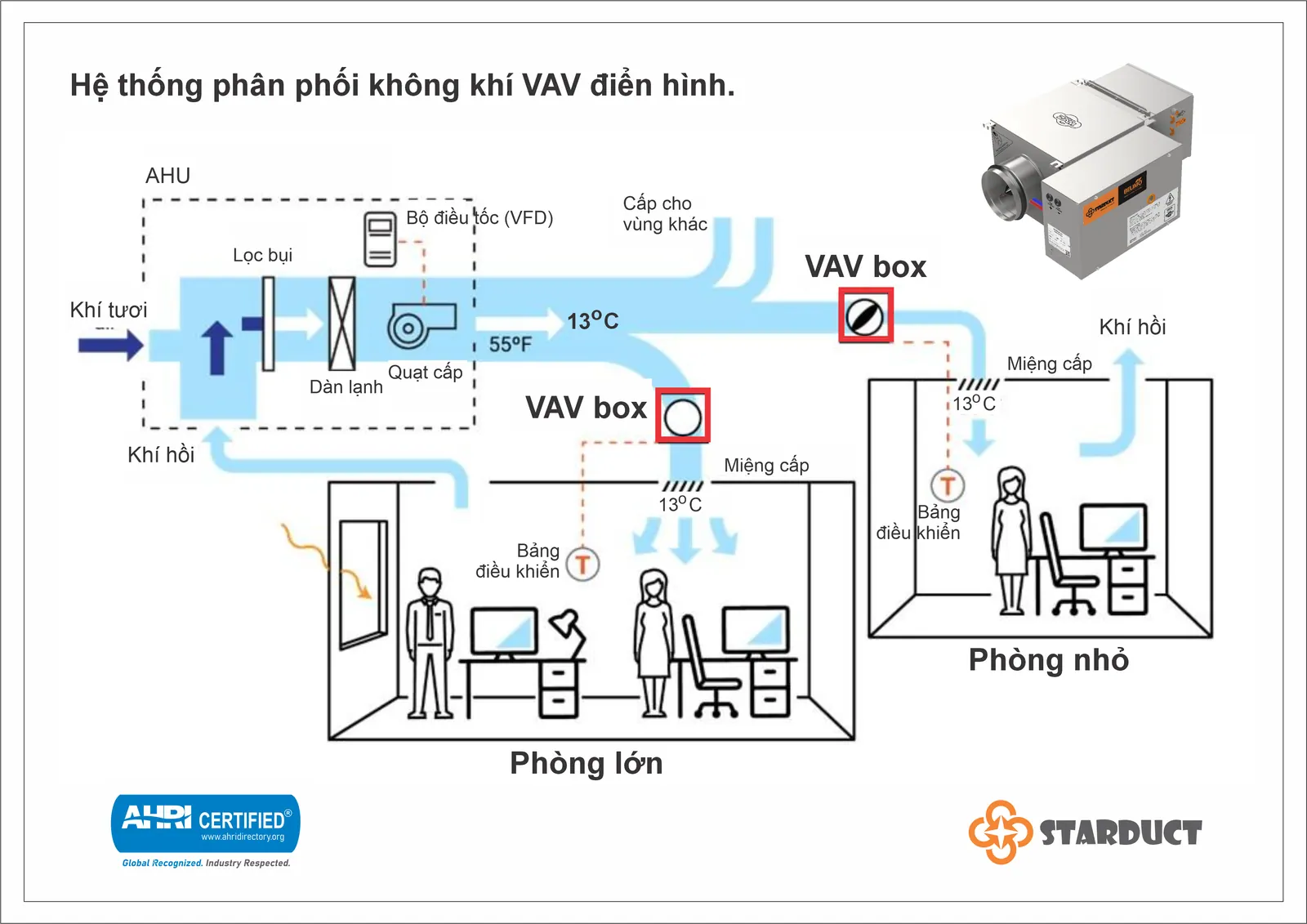
- Constant-Temperature Supply Air: A VAV system operates on the principle of a Variable Air Volume, Constant Temperature System. Cold air (typically around 13°C or 55°F) is cooled at the central Air Handling Unit (AHU) and supplied to the entire main ductwork system at a constant temperature.
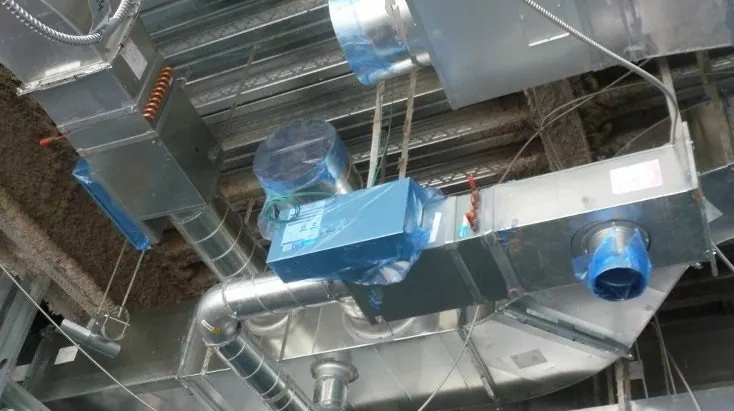
- Zoning with VAV Boxes: A VAV system allows different areas of a building to operate at different temperatures from the same system. Each zone has a VAV terminal unit (VAV terminal/VAV box) installed on the supply air branch duct. The number of zones in a VAV system equals the number of VAV boxes.
- Thermostat: Each zone is equipped with a thermostat. The thermostat continuously monitors the room temperature and compares it with the user's desired temperature setpoint (for example: 25°C).
- Damper Adjustment:
- The thermostat sends a signal to the VAV box controller, which controls an actuator connected to a control damper inside the VAV box.
- If the room temperature is too warm (high heat load), the controller instructs the damper to open further (it can open 100%) to allow more cold air into the room, thereby cooling it quickly.
- If the room temperature has reached the setpoint (heat load decreases), the damper partially closes to limit the amount of cold air entering, maintaining a stable temperature.
- Different heat loads: For example, a room with many people or servers generating a large heat load will require a larger supply airflow (CFM), so the damper opens wider. Conversely, an unoccupied room will require only the minimum airflow.
2. Energy Efficiency
A VAV system is considered the most energy-efficient method of air conditioning and delivers greater energy savings than a CAV system. The operating cost of a VAV system is lower than that of a CAV system.
The energy-saving capability of VAV comes mainly from reducing the operating power of the AHU fan and reducing the cooling or heating demand when the heat load in the building is low.
Fan Speed Control with a Variable Frequency Drive (VFD)
In a VAV system, the AHU fan is equipped with a Variable Frequency Drive (VFD), also called a Variable Speed Drive (VSD). The VFD allows the speed of the fan motor to be adjusted.
- Static Pressure Sensor: A static pressure sensor is installed inside the duct (usually at the farthest point, where the pressure drop is greatest) to continuously monitor the air pressure. The system is designed to maintain a constant static pressure in the supply duct.
- Fan Speed Adjustment:
- When the heat load decreases (for example, in winter or when rooms are unoccupied), the VAV boxes close to reduce the airflow into the rooms.
- As more dampers close, the pressure inside the duct rises.
- The static pressure sensor detects this pressure rise and sends a signal to the VFD.
- The VFD then reduces the rotational speed of the fan motor to reduce the airflow (CFM) and maintain a stable pressure.
- Electrical Energy Savings: Reducing the fan motor speed via the VFD significantly reduces electrical energy consumption (fan power falls with the cube of fan speed), ensuring no energy is wasted. A VFD system can save up to 40% or 60% of electrical energy.
In summary, a VAV system controls individual temperatures by varying the volume of cold air supplied to each zone through the VAV box and a damper controlled by a thermostat. At the same time, it achieves energy efficiency by reducing the AHU fan speed (using a VFD) when the total required airflow decreases.