
English version machine-translated from the Vietnamese original — under review.
The fundamental difference between a multi-zone VAV system (Multi-Zone VAV) and a single-zone VAV system (Single-Zone VAV) lies in their air distribution and control structure, as well as their scope of application.
Below is a detailed comparison based on information from the sources:
I. Differences in Applications
The choice between single-zone and multi-zone VAV depends on the spatial layout and the thermal load requirements of the area served.
| Characteristic | Single-zone VAV system (Single-Zone VAV) | Multi-zone VAV system (Multi-Zone VAV) |
|---|---|---|
| Scope | Designed for open-space HVAC applications. | Ideal for multi-room HVAC applications. |
| Type of space | Suitable for large areas with uniform thermal loads, such as restaurants, auditoriums/halls, open-plan offices, airports, warehouses, data centres and other open spaces in large commercial buildings. | Ideal for environments with many rooms or separate areas. |
| Examples | Restaurants, auditoriums, stadiums, airports, data centres. | Office buildings, hospitals, medical centres, schools, colleges, universities and other built environments. |
| Load profile | Suited to applications where the space thermal load undergoes significant fluctuation throughout the day. | Particularly effective where different areas experience significant fluctuations in space thermal load during the day. |
II. Differences in Structure and Components
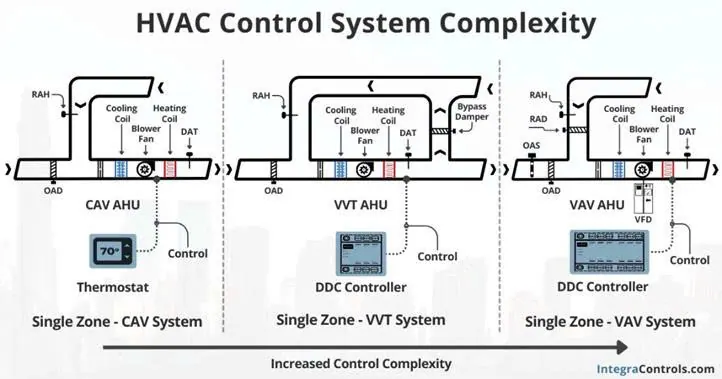
Both VAV systems evolved from CAV (Constant Air Volume) and VVT (Variable Volume and Temperature) systems, using variable frequency drives (VFD) to vary the airflow and optimise efficiency. However, the control structure at the point of distribution (terminal) is the fundamental difference.
1. Central Components
The central structure of both systems is relatively similar:
- Air handling unit (AHU): Includes a cooling coil (using compressors or chilled water).
- Blower Fan: Driven by a dedicated motor (inverter-duty motor).
- Variable frequency drive (VFD): The core component that gives the system its variable airflow characteristic.
- Ductwork: Air is distributed through supply and return ducts (plenum return is also common).
- Motorized Dampers: Used to control the amounts of outdoor air and return air for ventilation.
2. Zone Components and Control
This is the most important structural difference.
| Characteristic | Single-zone VAV system (Single-Zone VAV) | Multi-zone VAV system (Multi-Zone VAV) |
|---|---|---|
| Zoning | Serves a single thermal zone (open space). | The entire area served by the main AHU is divided into multiple thermal zones (different thermal zones). |
| Terminal units | Does not use intermediate terminal units (VAV Box) to regulate airflow at the point of use. | Uses dedicated VAV boxes or terminal units for each zone. |
| VAV box function | None. | The VAV box (Variable Air Volume box) is the terminal unit responsible for controlling the temperature in its zone. |
| Reheating | The central AHU includes a heating coil (electric or hot water) to control the common supply air temperature for the whole zone. | VAV boxes often integrate heating equipment (e.g. electric heaters or hydronic coils supplied by a boiler) to adjust the temperature specifically for each zone. |
| Main control | Usually uses Direct Digital Control (DDC) or a space thermostat to handle the control of the entire AHU for that zone. | The system uses DDC, in which both the AHU and the VAV boxes are fitted with DDC controllers. They communicate with each other over the BAS (Building Automation System) network. |
Summary of the structural differences
The fundamental structural difference is that multi-zone VAV uses Pressure-independent VAV boxes as terminal units to regulate airflow and temperature (usually via a reheat coil) for each smaller zone. Single-zone VAV, by contrast, has only one central AHU that regulates airflow and temperature (both cooling and heating) for a single large, uniform space.