

English version machine-translated from the Vietnamese original — under review.
The report analyzes all relevant duties – including the most-favored-nation (MFN) tariff rate, anti-dumping (AD) duties, countervailing duties (CVD), Section 232 tariffs and Section 301 tariffs – and any anti-circumvention measures, while comparing the similarities and differences between goods from Vietnam and goods from China. All information and figures cited are taken from official US Government sources (the Department of Commerce, the International Trade Commission (ITC), Customs and Border Protection (CBP), the Federal Register, etc.).
The specific products considered are: (1) Air-conditioning air outlets (Air Grille, Register, Wall Grille); (2) Supporting bars made of steel tube (Supporting Bar by steel tube); (3) Solar racks and accessories (Solar rack & accessories made of aluminum profiles and steel sections).
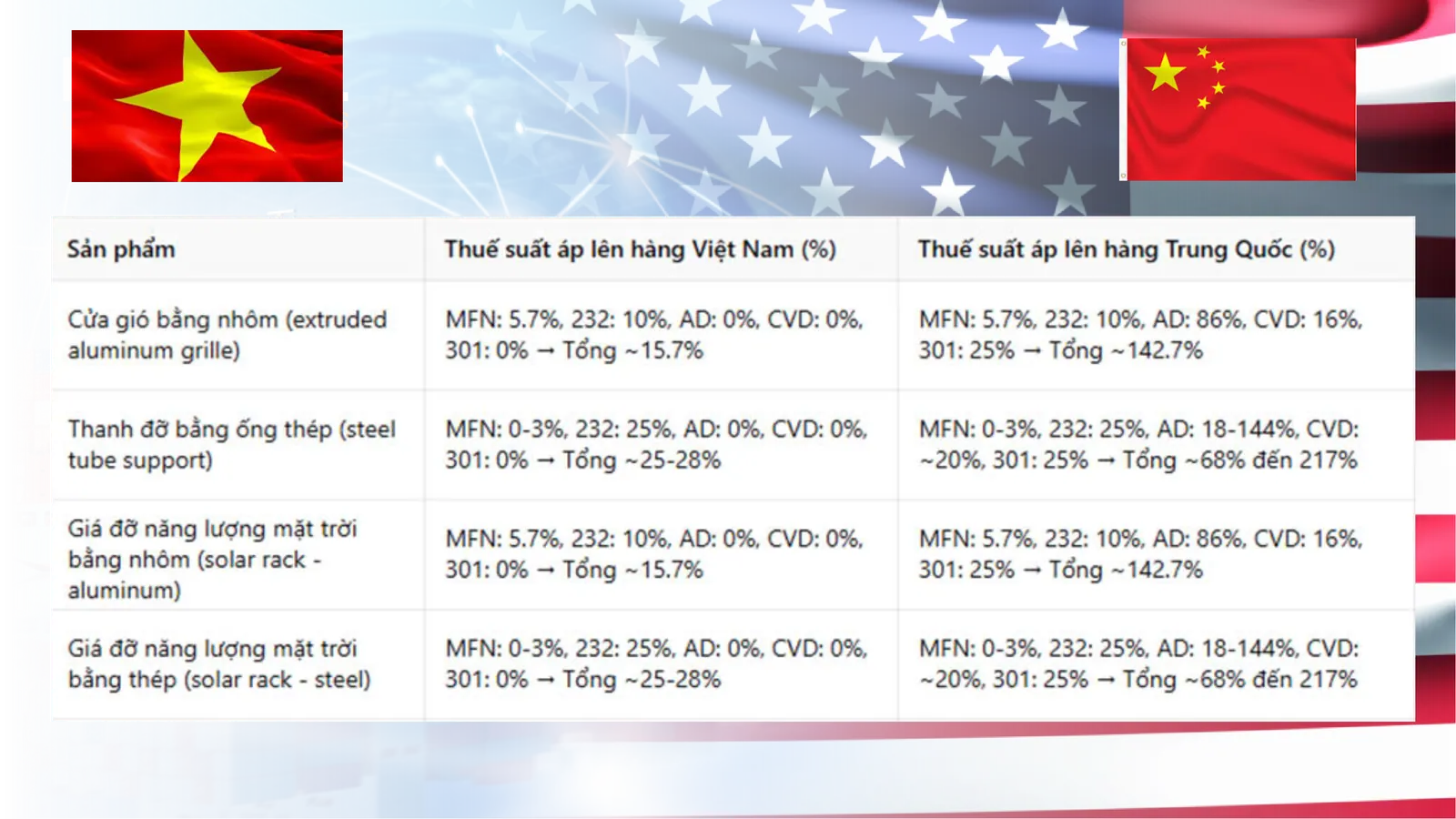
Summary: Vietnamese Goods vs. Chinese Goods
- MFN tariff: Same – Both Vietnam and China are subject to the same MFN rates under the US tariff schedule (as both have normal trade relations status). MFN rates for finished aluminum and steel products are generally low (0-6%). There is no country differentiation in the base tariff.
- Section 232 tariffs (steel, aluminum): Same – The US imposes 25% (steel) and 10% (aluminum) on imports from all countries (except certain exempted countries). Both Vietnamese and Chinese goods are subject to these tariffs when entering the US afslaw.com.
- Section 301 tariffs: Clearly different – Only Chinese goods are subject to Section 301 tariffs (an additional ~25%); Vietnamese goods are not afslaw.com. This is a major advantage for Vietnam, partly offsetting the disadvantage of the identical Section 232 tariffs.
- AD duties: Very different – Many Chinese products (aluminum extrusions, steel pipes and tubes, steel sections, steel racks, etc.) are subject to high AD duties in the US (from several tens to several hundreds of %) federalregister.gov. The corresponding Vietnamese products have for the most part not yet been subject to AD duties (0%). For example: Chinese aluminum extrusions are subject to ~86% AD wiley.law , Vietnam 0%; Chinese steel racks 18-144% federalregister.gov Vietnam 0%.
- CVD duties: Different – In China, many products are subject to CVD (due to receiving subsidies) at high rates (several tens of % or more) 2017-2021.commerce.gov. Vietnam is for the most part not subject to CVD (as it has not been found to provide significant subsidies).
- Anti-circumvention: Specific case – The US has a precedent of applying anti-circumvention orders to Vietnamese goods made from Chinese raw materials (in the cases of cold-rolled steel and coated steel sheet) federalregister.gov, 2017-2021.commerce.gov
. This means that if Vietnamese goods are genuinely of Vietnamese origin, they benefit from the preferential tariff treatment (MFN + 232 only), but if they are found to be merely minimally processed from Chinese raw materials, the US will apply duties as if they were Chinese goods. China does not have this advantage – Chinese goods entering the US directly are automatically subject to all the high duties, whereas Vietnamese goods need to maintain their reputation for "genuine origin" to retain their advantage.
Conclusion
As of early April 2025, US tariff policy on fabricated aluminum and steel products from Vietnam is significantly more favorable than for Chinese goods.
- Vietnamese goods are subject only to the basic import duty (MFN) and Section 232 tariffs, like other countries, are not subject to Section 301 tariffs and are for the most part not affected by AD/CVD.
- By contrast, Chinese goods, in addition to MFN and Section 232, are also subject to Section 301 tariffs (25%), and most similar products are bound by AD/CVD orders with very high duty rates. As a result, the total tariff burden on Chinese goods entering the US is much greater than on Vietnamese goods.
- For example, a set of aluminum air outlets from China may bear MFN ~5% + 232 (10%) + AD (~86%) + 301 (25%) = over 120% of its value, whereas similar air outlets from Vietnam bear only MFN ~5% + 232 (10%) (with no AD or 301) = about 15% – a very large difference.
However, Vietnam's tariff advantage comes with the responsibility to comply with rules of origin. The United States has been stepping up its monitoring to ensure that Chinese goods are not "disguised" as Vietnamese to obtain preferential treatment. In the long term, Vietnam maintaining its reputation for origin and avoiding anti-circumvention measures will help it retain its competitive advantage over China in the US market. Exporters need to closely follow changes in US tariff policy (for example, the results of Section 301 and 232 reviews or new AD investigations) in order to respond proactively and seize opportunities.
References: The figures and conclusions above are compiled from official notices in the Federal Register, decisions of the US International Trade Commission, and press releases from the relevant US agencies, ensuring accuracy and timeliness usitc.gov, 2017-2021.commerce.gov, wiley.law, afslaw.com ... (See details in the source citations below).
Compiled by the Market Research & Development Department
Star Asia Company