
English version machine-translated from the Vietnamese original — under review.
1. Introduction to the Single Zone VAV System
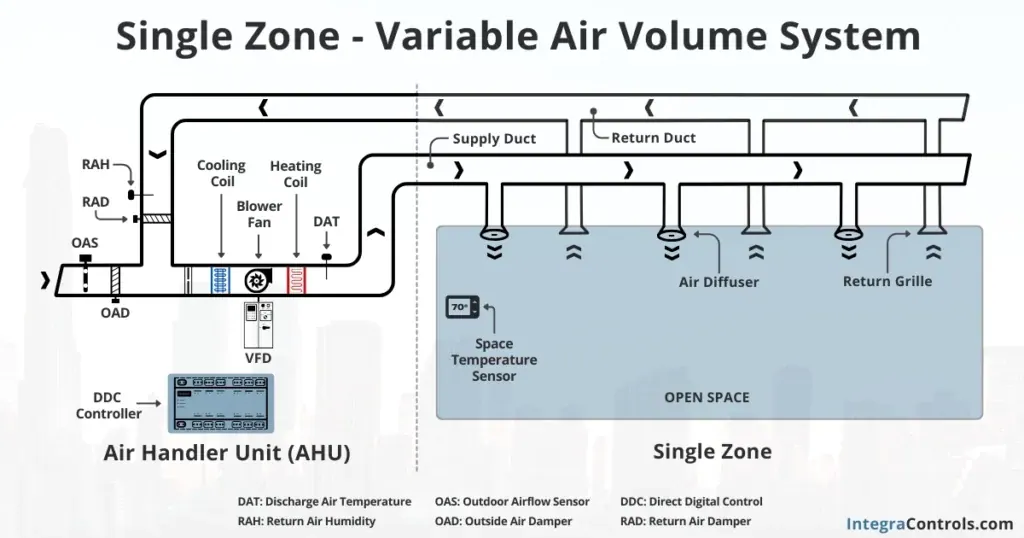
The single zone Variable Air Volume (VAV) system is a specialised type of air-conditioning (HVAC) system designed for open spaces in commercial buildings and large facilities. The main objective of this system is to "improve occupant comfort by adjusting both the supply airflow and the discharge air temperature, in order to meet the actual thermal load requirement of each area." ("What Is a Single Zone VAV System?")
The VAV system represents an evolution from older systems such as Constant Air Volume (CAV) and Variable Volume and Temperature (VVT), delivering "superior energy efficiency" and a greater ability to "ensure comfort". ("Applications of the VAV System")
2. Applications and advantages of the Single Zone VAV System
Single zone VAV systems are widely used in many large, open spaces such as "restaurants, auditoriums, airports, warehouses, gyms, data centres, open-plan offices, etc." ("Single Zone VAV System")
The standout strength of VAV is its ability to "flexibly adjust airflow according to the actual thermal load, helping to maintain comfort while optimising the system's electrical energy consumption." ("Single Zone VAV System") The development and affordability of variable frequency drives (VFDs – Variable Frequency Drives) have contributed significantly to the growth in market share of VAV systems.
3. Main components of the Single Zone VAV System
The core mechanical components of a single zone VAV system include:
- Air handling unit (AHU): Integrates a cooling coil (using a compressor or chilled water) and a heating coil (using electricity or hot water).
- Blower fan: Driven by a fan motor.
- Variable frequency drive (VFD): The "component that changes airflow according to actual demand" ("Components of the single zone VAV system") by controlling the speed of the blower fan.
- Ductwork system: Comprises supply ducts and return ducts (sometimes the ceiling space is used as a return plenum).
- Motorised dampers: Control the amounts of outdoor air and return air to regulate the intake of outside air.
- Air outlets: Distribute air into the occupied space.
- Controller: Usually a direct digital controller (DDC – Direct Digital Control), providing "flexibility in setting up the sequence of operations, monitoring and fault detection." ("Single zone VAV system diagram")
4. Operating principle of the Single Zone VAV System
To ensure comfort, the single zone VAV system controls three main variables:
- Space temperature: Controlled by simultaneously adjusting the supply air temperature and the supply airflow.
- Supply air temperature control: Maintains the supply air temperature below the room set-point temperature when cooling (e.g. 55°F) and above it when heating (e.g. 90°F).
- Supply airflow control: The fan speed is adjusted via the VFD, increasing when the room temperature exceeds the set point and decreasing when the temperature falls. The minimum fan speed is limited to ensure ventilation and to protect the compressor.
- Space humidity: Maintains relative humidity within an acceptable range (e.g. 30%RH – 60%RH). The system performs "passive dehumidification" by creating conditions for water vapour to condense on the surface of the cooling coil.
- Humidity Override Sequence: If humidity is high, the system activates override mode, lowering the supply air temperature to increase condensation. In this mode, both the cooling coil and the heating coil may operate simultaneously to control temperature and humidity. This sequence should not occur frequently; if it does, potential causes such as maintenance, air balancing or sensor calibration should be checked.
- Outdoor fresh air quantity (ventilation): This is an "extremely important factor contributing to indoor air quality (IAQ)." ("Ventilation in single zone VAV systems")
- Ventilation standard: The system must comply with ASHRAE® Standard 62.1, which specifies "the minimum ventilation airflow... applicable under all load conditions or during dynamic reset." ("Ventilation standard for single zone VAV systems")
- Ventilation control mechanism:Minimum Blower Fan Speed: The VFD must not be set below the speed required to maintain minimum ventilation.
- Outdoor air damper control (OAD Control): The OAD damper modulates to maintain the minimum ventilation airflow.
- Return air damper control (RAD Control): If the OAD is fully open and sufficient fresh air has still not been reached, the RAD damper gradually closes to achieve the desired airflow.
- Ventilation Reset: Uses a mechanism for estimating the number of occupants (e.g. CO₂ sensors) to "automatically reduce the required outdoor air quantity to improve efficiency" ("Ventilation reset in single zone VAV systems") during periods of low occupancy, known as demand-controlled ventilation (DCV).
- Ventilation and building pressure: "The total fresh air supplied to the building must be equal to or greater than the total air exhausted, under all load conditions and all dynamic reset modes" in order to keep "the overall pressure in the building always positive (positive pressure), preventing the infiltration of untreated air from outside." ("Ventilation and building pressure in single zone VAV systems") Closing the outdoor air damper to reduce load is a common mistake that can lead to increased humidity and CO2 and to pressure imbalance.
5. Comparison of VAV with single zone CAV and VVT systems
Although VAV systems stand out for energy efficiency, CAV and VVT are still commonly used. → Reason: When selecting an HVAC system, engineers must also weigh additional factors such as:
- Initial investment cost;
- Complexity of control;
- Requirements for comfort and stable operation.
System Cost
The cost of an HVAC system comprises 3 main components:
- Mechanical equipment and installation cost
- Control equipment and installation cost
- Maintenance and operating cost
Mechanical Equipment and Installation Cost
The mechanical equipment and installation costs of CAV, VVT and VAV systems do not differ greatly.
However:
- VVT has an additional bypass duct, a motorised control damper and an actuator;
- VAV differs mainly in having a variable frequency drive (VFD) to control fan speed.
→ For large motors, it is sometimes necessary to replace the standard motor with a dedicated inverter-compatible motor (inverter-duty), which increases the initial investment cost.
Control Equipment and Installation Cost
The costs related to control equipment, materials and installation differ significantly between CAV, VVT and VAV systems.
- In single-zone applications, a CAV system usually uses only a basic thermostat for control.
- Meanwhile, VVT and VAV require a more complex and detailed direct digital control (DDC) system.
→ It is precisely this difference in control complexity that increases the implementation cost of VVT and VAV systems compared with CAV.
However, because of the increased control cost, CAV remains common in single-zone applications, despite its lower energy efficiency.
Maintenance Cost
Maintenance costs do not differ much between the systems in mechanical terms.
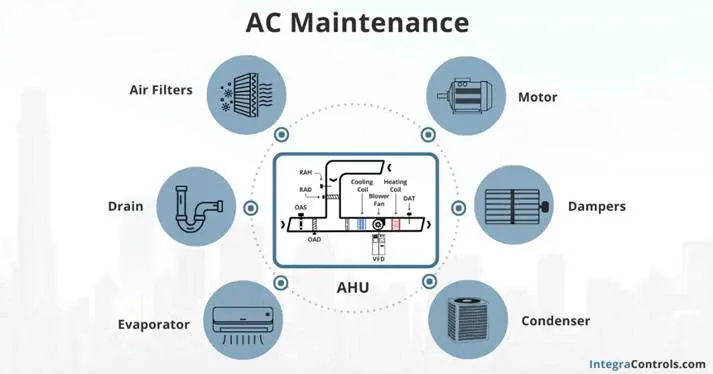
Routine maintenance tasks are always necessary, including:
- Replacing air filters;
- Cleaning the evaporator coil (evaporator) and condenser coil (condenser);
- Flushing and cleaning the drainage system;
- Replacing fan belts;
- Checking the outdoor air supply damper.
The major difference lies in the controls
A VAV system requires more thorough maintenance of the ventilation control system, because it additionally has:
- Outdoor air (OAD) and return air (RAD) dampers;
- An outdoor airflow sensor (OAS).
→ These devices need:
Periodic checking and calibration to ensure accuracy;
Cleaning of the airflow sensor – because dust readily accumulates after a period of use.
Table 1. Comparison of system costs between CAV, VVT and VAV systems
System Cost CAV System VVT System VAV System Mechanical equipment Normal Normal Normal Mechanical installation Normal Normal Normal Control equipment Normal Additional Additional Control installation Normal Additional Additional Mechanical maintenance Normal Normal Normal Control maintenance Normal Normal Additional - Table 2: Control components of CAV, VVT and VAV systems
Control component CAV System VVT System VAV System Main control Thermostat DDC controller DDC controller Blower fan (Blower Fan) Thermostat Relay Relay Cooling coil (Cooling Coil) Thermostat Relay Relay Heating coil (Heating Coil) Thermostat Relay Relay Room temperature sensor Thermostat Sensor Sensor Room humidity sensor Thermostat Sensor Sensor Outdoor air damper Thermostat Open/close Modulating actuator Bypass damper None Modulating actuator None Supply air temperature sensor None Sensor Sensor Return air damper None None Modulating actuator Variable frequency drive (VFD) None None Modulating signal Fresh airflow sensor None None Sensor
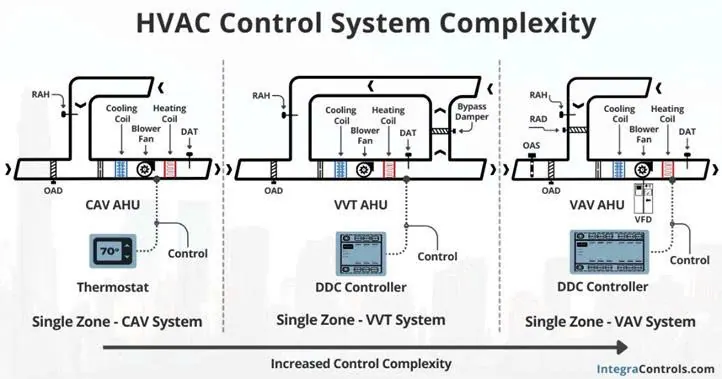
Illustration: Control complexity of CAV – VVT – VAV
- CAV: Uses only a basic thermostat.
- VVT: Uses a DDC controller + modulating bypass damper.
- VAV: Uses a DDC + VFD + outdoor/return air damper control + temperature/humidity sensors.
→ VAV has the highest control complexity of the 3 systems.
6. Summary
The single zone VAV system is an advanced and efficient HVAC solution, particularly suitable for large open spaces. It "helps increase comfort by adjusting the airflow and supply air temperature according to the actual cooling/heating load." ("Summary") Compared with CAV and VVT, VAV is "superior in efficiency, adaptability and energy savings," despite its higher initial investment cost and control complexity. The combination of precise control of temperature, humidity and ventilation enables VAV to deliver optimal indoor air quality and sustained comfort for occupants.
Source and images: https://integracontrols.com/single-zone-vav/
Edited and translated by: Research and Development Department - NSCA