
English version machine-translated from the Vietnamese original — under review.
PART 5. Sales Consulting Skills
Preparing a Convincing Technical Proposal: For Starduct's sales engineers and distributors, one of the key tasks is to build a technical proposal that helps the customer clearly understand the solution and choose it with confidence. A convincing proposal should include:
- Solution overview: Begin by summarising the customer's needs (building type, air conditioning requirements) and introducing the proposed solution (VAV, VRV or a combination). Briefly explain why this solution is suitable (for example: "A 20-storey office building with a floor area of 1000 m² per floor and a need for zone-by-zone control – a water chiller system with central VAV air conditioning will optimise investment and operating costs, while ensuring flexibility for the office space layout").
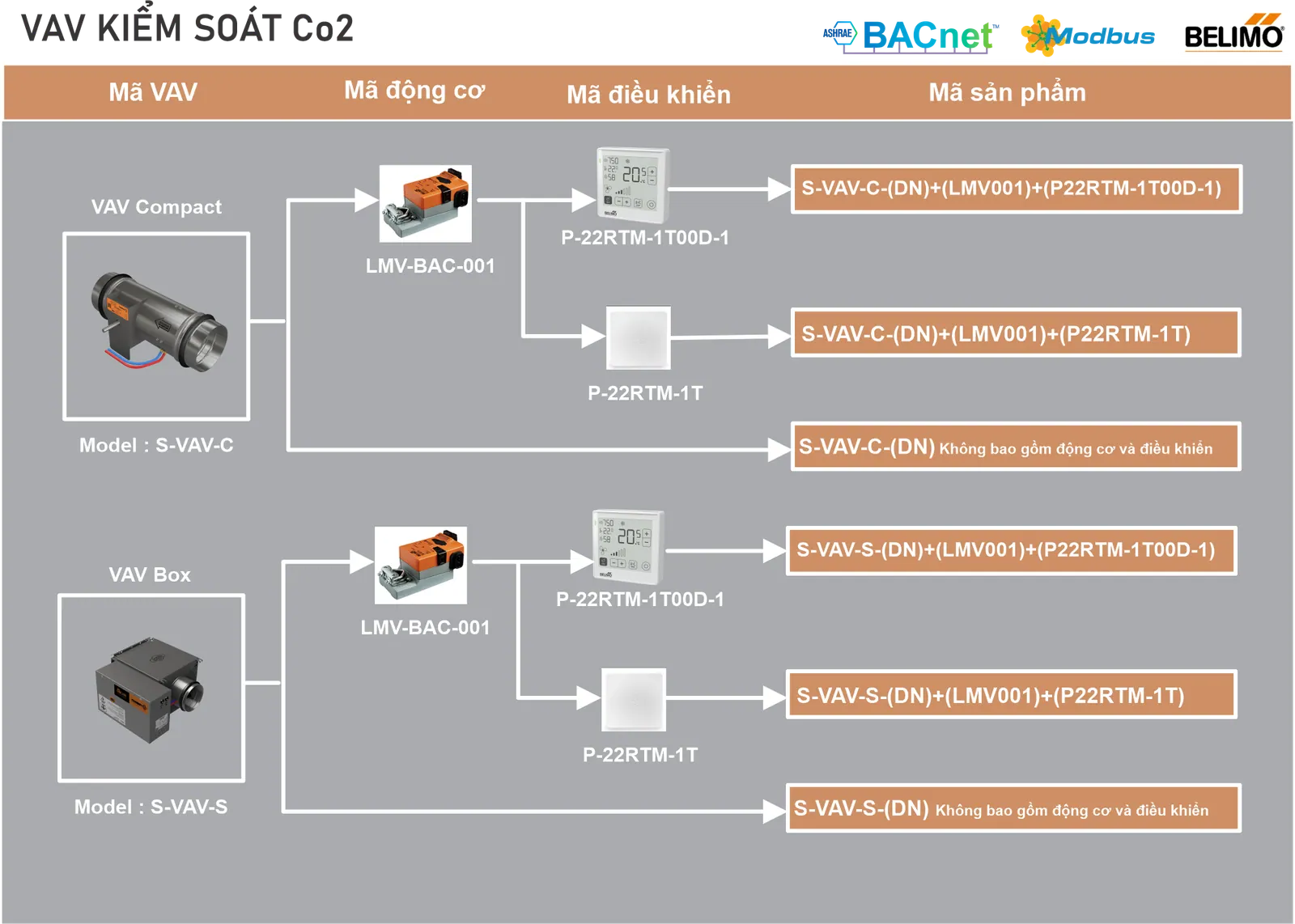
- System technical details: Present the proposed system configuration: number of AHUs, chiller or VRF capacity, number of VAV boxes, schematic layout. Use diagrams and schematic drawings so the customer can easily visualise it. Tables listing the key parameters (airflow, cooling capacity, noise level, COP efficiency,…) of the equipment offered. If Starduct products are included, clearly state their advantages (for example: Starduct VAV boxes have good insulation, precise control dampers, and a factory-integrated controller – helping to reduce installation costs, etc.). Customers are often impressed if the documents include photos of the actual products and of similar completed projects.
- Comparison of options (if needed): If the customer is undecided between two options (e.g. VAV vs VRF), the engineer should prepare a comparison table covering technical and economic aspects: comparing the number of units, complexity, investment cost, operating cost, maintenance and service life. For example: "The VRF option requires ~200 indoor units & 10 outdoor units, with equipment costs 15% higher than the Chiller/VAV option (1 chiller of 500RT & 200 VAV boxes). However, VRF reduces ductwork and allows a false ceiling ~30 cm lower on each floor". This comparison table should be clear and honest, based on data (sources or similar projects may be cited).
- Benefits to the customer: This is the key section for persuasion. List the main benefits linked to the customer's needs: cost savings (investment or operating), greater comfort for occupants, flexibility for expansion, brand and equipment durability, Starduct's support services. For example, emphasise ROI: "The VAV system saves about 30% of electricity per year compared with the old system numberanalytics.com, equivalent to ~VND 200 million, paying back the difference in investment within 3 years". If Starduct has a successful reference project, include it as an illustrative case study (for example: "Building X in Hanoi applied a similar solution; after 1 year of operation, electricity costs fell by 25% and staff satisfaction rose because the temperature in each room was more stable").
- Calculations and standards: To increase credibility, the proposal may include load calculations (if the customer is interested in the details), preliminary design drawings and an equipment list, and should clearly state compliance with the relevant technical standards (TCVN, ASHRAE, ISO). This demonstrates the professionalism and scientific basis of the proposal.
A good technical proposal must be both detailed (for the customer's technical department) and easy to understand (for management or the finance department). Therefore, it should have a brief executive summary, followed by a detailed analysis. The proposal should be clearly designed, with charts, tables and visual images. Avoid getting too caught up in technical jargon; instead, link it to practical benefits (for example, say "30% electricity savings" rather than just "1.2 times higher COP").
Analyzing ROI and TCO for each project: Financial analysis is a valuable skill for sales engineers when advising on expensive HVAC solutions. Customers are usually interested in two main indicators: ROI (Return on Investment) – the time needed to recover the additional investment through operating savings, and TCO (Total Cost of Ownership) – the total cost of ownership over the system's life cycle (including initial investment + operation + maintenance – residual value). To be convincing, the engineer should prepare spreadsheets for both options (e.g. VAV vs VRF) with clear assumptions:
- Initial investment cost: List equipment prices, installation and commissioning. For example: VAV option: 500RT chiller, cooling tower, AHUs, VAV boxes... estimated total VND 20 billion. VRF option: 10 VRF systems, 200 FCUs... total VND 22 billion. Do not forget ancillary costs such as ductwork, insulation, water pumps, electrical work... for each option (VAV usually adds ductwork, VRF adds copper piping). Figures can be taken from internal quotations or similar projects.
- Annual operating cost: Calculate based on capacity, efficiency and operating hours. For example: VAV option: cooling capacity 500RT, chiller COP ~5, AHU fans 30 kW, operating 2000 hours/year -> energy consumption ~??? kWh/year. VRF option: total compressor power 600 kW, IPLV efficiency ~4, operating 1800 hours/year (since units can be switched off locally) -> ??? kWh/year. Studies can be cited: "GSA reports that VRF systems can save ~30% of HVAC electricity costs ambientedge.com; for this building that is equivalent to ~VND 500 million/year". Besides electricity, also include water costs (if there is a cooling tower) and operating labour costs (a chiller requires engineers; VRF may need fewer?).
- Periodic maintenance cost: Estimate the annual maintenance cost: e.g. chiller oil change every 2 years, safety inspections; for VRF, refrigerant top-up in case of leaks, annual cleaning of outdoor/indoor units... This can be given as a % of the investment (e.g. VAV ~2%/year, VRF ~3%/year) or as a fixed figure. Note that VRF has many distributed units, so the labour cost of maintaining each FCU is also significant.
- Service life and depreciation: Assume the number of years of use (chiller ~20 years, VRF ~15 years until the major compressors must be replaced). Calculate the annual depreciation. For a 20-year TCO analysis, for instance, the replacement of the VRF after 15 years (capital refresh cost) must be included.
- Cash flow analysis: Prepare a cash flow table for 5, 10 or 20 years. Calculate the NPV (net present value) if needed (using a discount rate). From this, derive the payback period – the year in which the cumulative operating savings of option A exceed the initial investment difference compared with B. For example: "Although the initial investment is 2 billion higher, thanks to operating savings of ~500 million/year, the VRF system will pay back after ~4 years, and from year 5 it starts generating net savings". Conversely, if the payback period is too long (over 10 years), the customer may choose the lower-investment option.
- Scenario analysis: To be more persuasive, scenarios can be presented: electricity prices rising 5%/year, operating hours increasing/decreasing, different interest rates – to see which option carries more risk. For example, if electricity prices rise sharply, the energy-saving option becomes even more advantageous (ROI shortened to 3 years, say). This shows the customer the sensitivity and helps them decide based on their own situation.
In sales consulting, a TCO chart is very useful: plot 2 cumulative cost curves by year for the two options. The crossover point is the ROI point. Corporate customers usually prefer looking at a graph rather than a table of numbers. Make sure all figures are transparent and referenced. For example, use energy simulation results (EnergyPlus) or actual case studies. When customers clearly see the long-term financial picture, they are more easily persuaded than when they only look at the initial investment price.
Tailored Consulting Strategies for Different Project Types: Each type of building has its own characteristics, so the sales engineer needs to adapt the consulting approach, emphasising the different benefits that match the project owner's priorities:
- Office buildings: Office tenants care about low operating costs and space flexibility. For multi-storey office projects, emphasise that a central VAV system allows subdivision into zones by room/department, which can easily be changed when a tenant company expands or partitions rooms. Clearly state the advantages in air quality and comfort: VAV supplies sufficient fresh air to each zone and provides better humidity control (suitable for a working environment). In addition, low noise is also important – VAV units located above a sound-insulated ceiling void are much quieter than multiple local indoor units mounted in the room. Economically, offices operate during business hours, so air conditioning can be switched off outside these hours – both VRF and VAV can do this via BMS schedules, but VAV with a large chiller plant can also be combined with thermal storage (chilled water storage tanks) to run the chillers during off-peak hours and save costs (for advanced consulting). Focus for offices: ROI and flexibility.
- Hotels: Hotels prioritise the guest experience and energy savings in unoccupied rooms. Hotel guest rooms usually use local air conditioning (VRF or FCU) so guests can adjust it themselves. Very few hotels use VAV for bedrooms because it is difficult to provide individual control for each room. However, a combined solution can be proposed: guest rooms use FCU/VRF, while the common areas (lobby, corridors, conference rooms, restaurants) use central VAV. In these large spaces, VAV is effective for zoning (e.g. a ballroom can be divided into 4-6 VAV zones depending on where crowds gather) and ensures low noise for luxury areas. Emphasise the humidity control capability of VAV (very important in tropical hotel lobbies to avoid a muggy feeling). The smart BMS should also be mentioned: integrated with the booking system – unoccupied rooms are set to a higher temperature (saving electricity). VRF systems can also do this, but each FCU must be connected, which is more complex than VAV, which is already part of the overall BMS. Hotel consulting needs to be balanced: if the customer insists on VRF throughout, you can agree on VRF for the rooms while recommending a small chiller for the public areas to improve stability and service life (a large chiller is more durable than many VRF units). Aesthetics and space should also be mentioned: VAV requires a higher ceiling void to conceal the ductwork, while VRF needs many louvres for the outdoor units (which may affect the architecture). Find out what the project owner values in order to advise accordingly.
- Hospitals: For hospitals, the top priority is precise environmental control (temperature, humidity, room pressure) and system reliability (no downtime). Here, VAV usually dominates in the design of areas such as wards and operating theatres – because a central system can more easily provide fresh air, clean filtration and pressurisation as required. The sales engineer should emphasise: a central VAV solution allows centralised management of air quality (e.g. using AHUs with UV germicidal lamps, creating positive/negative pressure via VAV) much better than many separate units. Hospital consulting should provide examples: "An operating theatre must be maintained at 18°C, 60%RH and a positive pressure of +20 Pa – a VAV system integrated with the BMS can do this precisely, with N+1 redundancy. Isolation rooms need a negative pressure of -15 Pa – only feasible with a central air distribution system." In addition, hospitals operate 24/7 with huge energy costs – energy-optimising solutions such as VAV, heat recovery at the AHUs and heat pumps using waste heat will be attractive. When comparing with VRF, its drawbacks can be pointed out: VRF can hardly supply 100% fresh air to operating theatres, and refrigerant leaks in enclosed spaces are dangerous (under medical safety standards). Consulting should strongly emphasise safety and stable operation: a central system is easier to maintain, and hospital technical staff are usually more familiar with chillers/water systems. Of course, some support areas (administration building, doctors' rest rooms) can use VRF, but the core medical areas should be persuaded to use VAV. Prepare the relevant standards (ASHRAE 170, TCVN for operating theatres) as evidence.
- Shopping malls: Malls need flexibility according to visitor load (crowded at weekends, quiet on weekdays) and must ensure comfort in large public areas. Typically, shopping centres use large AHUs combined with VAV for lobbies and corridors, while small individual shops may be leased with the ceiling space – each shop installs its own FCU or branch VAV. Consulting here focuses on energy savings at part load: VAV can reduce airflow when there are few visitors, especially at night when only light ventilation is needed to maintain the environment. Compared with older CAV systems (blowing the same amount at all times), VAV saves significantly – you can cite "VAV systems save up to 30% compared with CAV in commercial buildings" numberanalytics.com. Also emphasise the ability to maintain a stable temperature even when entrance doors are opened frequently – because VAV can ramp up and down flexibly when doors open (temperature/pressure sensors detect the change). Malls place great importance on the customer experience: they do not want customers to be too hot or freezing cold. Explain that VAV with fine zone control avoids the situation of "too cold in one place near the air outlet, too hot in another" – something a system that supplies air uniformly throughout cannot avoid. In addition, if Starduct has architectural air outlets and VAV products, they can be introduced to preserve the appearance of the ceiling.
- Industrial factories: It depends on the type of factory, but the priority is usually not luxury but durability and ease of maintenance. Where ceilings are high and spaces are open, simple systems such as ventilation fans or CAV are sometimes chosen because of their low cost. To sell VAV to a factory, you need to find their pain point: for example, an electronics factory requires tight temperature and humidity control – VAV can maintain uniform conditions, whereas many local units might leave some areas out of balance. Or a large workshop is hot during daytime production and idle at night – VAV allows air conditioning to be reduced to save energy on the night shift, which is difficult to coordinate with other systems. In general, factories need a short ROI, so emphasise energy savings (since electricity costs are significant). You could even propose an ESCO model: invest in the VAV solution and share the savings. In addition, factories may care about durability: convince them that AHU + VAV is a robust system with few minor breakdowns, with central compressors under periodic maintenance – whereas hundreds of small compressors (VRF) may suffer frequent minor failures and be harder to repair (requiring specialist technicians). If the factory is in an area with a weak power grid, you can point out that a chiller is easier to integrate with backup generators, whereas many VRF systems are difficult to synchronise on a generator. Gather specific information about the factory so your advice is on target.
In short, a good sales engineer needs to listen to the customer's specific needs, identify their priorities (cost, comfort, aesthetics, energy savings, new technology…) and then adjust the focus of the presentation. With finance-oriented people, talk about ROI and TCO. With technically oriented people, talk about performance and features. With high-end project owners, emphasise brand and modernity (e.g. smart systems, AI integration, environmentally friendly with LEED green certification). You should also prepare frequently asked questions and answers in advance. For example: "If the system is that complex, will it be difficult to operate?" – answer: Our BMS is very user-friendly and training can be completed in 1-2 weeks; in addition, Starduct offers supporting maintenance services.; or "What if there is a power outage?" – There are backup generators, and the fail-safe damper design ensures safety…. Thorough preparation and in-depth knowledge build customer trust, which in turn helps close the contract successfully.