
English version machine-translated from the Vietnamese original — under review.
EU import tariffs and protective measures for aluminium and steel
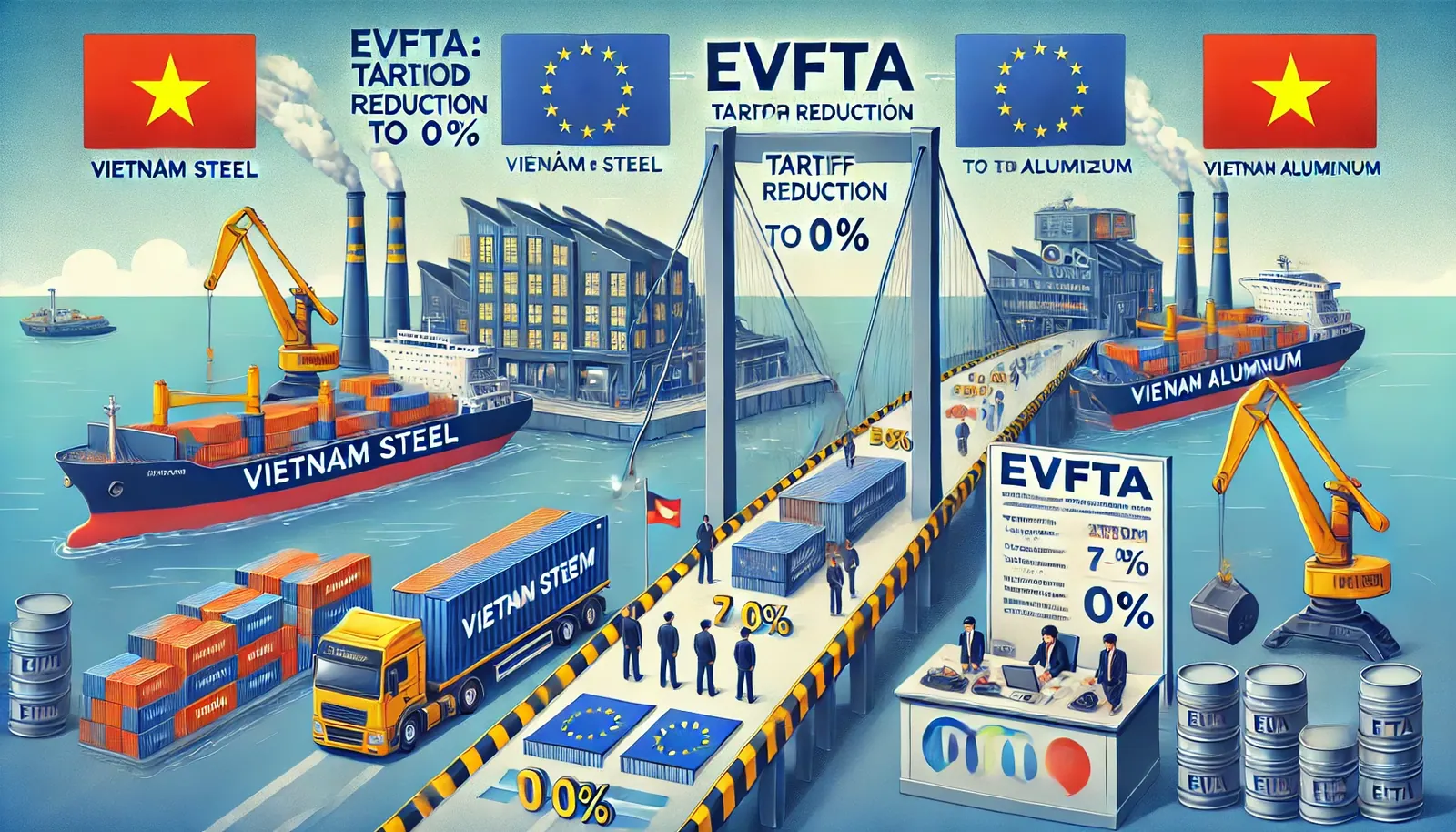
Basic tariffs and the EVFTA: The European Union applies a common import tariff (MFN) on aluminium and steel from non-EU countries. Thanks to the EU-Vietnam Free Trade Agreement (EVFTA), in force since 2020, many Vietnamese aluminium and steel products enjoy deep tariff cuts when entering the EU, moving towards 0% after a 7-8 year roadmap baodauthau.vn. However, to benefit from EVFTA preferences, goods must meet strict rules of origin.
Safeguard measures: Since 2018, the EU has applied safeguard tariff-rate quotas on imported steel to protect production within the bloc. Specifically, the EU allocates duty-free quotas to steel-exporting countries on a quarterly basis; imports exceeding the quota are subject to a 25% duty reuters.com. This measure was introduced after the US imposed steel tariffs in 2018, to prevent cheap steel from being diverted into the EU reuters.com. By early 2025, the European Commission was considering tightening the quotas over concerns that new US tariff plans would cause surplus steel to flood into Europe reuters.com. Under WTO rules, safeguard measures may last at most 8 years (expiring in mid-2026), so the EU expects to seek a replacement or extension mechanism after that date reuters.com. In February 2025, French Industry Minister Marc Ferracci also called for the “safeguard clause” to be adjusted to tighten steel imports, arguing that **“too much subsidised Chinese steel is entering the EU, creating difficulties for the European steel industry”** gazdaujourdhui.fr. This reflects France's stance of wanting to protect its domestic steel industry, where demand has fallen by ~20% over the past 5 years gazdaujourdhui.fr
Anti-dumping (AD) and countervailing (CVD) duties: The EU actively uses trade defence instruments for aluminium and steel:
- Steel: The EU has imposed numerous AD/CVD duties on steel from China and other countries. For example, in November 2022 the EU imposed anti-dumping duties of €239 to €607 per tonne on electrolytic chromium-coated steel (ECCS) from China and Brazil, to protect ~1,000 workers in the packaging steel industry in France, Germany, Spain and Italy policy.trade.ec.europa.eu. Notably, to prevent duty circumvention, on 07/05/2024 the EC extended the AD duty of 19,3% and the CVD duty of 20,5% (applied to cold-rolled stainless steel from Indonesia) to imports from Vietnam, Taiwan and Turkey as well eurofer.eu. The investigation found that these countries were importing cheap stainless steel feedstock from Indonesia for processing and then exporting it to the EU, nullifying the original anti-dumping duties eurofer.eu. In addition, in August 2024 the EU initiated an anti-dumping investigation into hot-rolled steel coil from Vietnam (together with India, Japan and Egypt) vietnamnews.vn. This is a sign that the EU is concerned Vietnamese steel may be dumped as its market share grows rapidly.
- Aluminium: The EU also applies AD duties to Chinese aluminium products. Since October 2020, the EU has imposed 5-year anti-dumping duties on aluminium extrusions (bars, profiles) from China, at rates of around 21% – 32% depending on the producer italpres.com. In 2021, the EU went on to impose provisional AD duties of 19,6% – 47,3% on certain Chinese **flat-rolled aluminium products (aluminium foil, aluminium sheet)** italpres.com. These measures respond to Chinese subsidies and dumping of aluminium – evidenced by Chinese aluminium prices being distorted by subsidised energy and raw material costs italpres.com. Thanks to the EVFTA, Vietnam is not subject to high basic tariffs like China, and tariffs on aluminium exported from Vietnam to the EU will fall to 0% by 2028 baodauthau.vn. However, the EU may investigate if it suspects Vietnamese aluminium uses cheap raw material from China to evade duties.
Carbon tax (CBAM): An important new EU policy is the Carbon Border Adjustment Mechanism (CBAM), applied on a trial basis from 2023 with full charging expected from 2026. CBAM will impose the cost of CO₂ emissions on imported steel and aluminium to equalise carbon costs with products made in the EU. It is not a traditional “import tariff” but will have a similar effect on the price of imported goods. The EU plans to gradually phase out free CO₂ allowances for the steel industry over 2026-2034, replacing them with CBAM trungtamwto.vn. CBAM is expected to counter “carbon leakage”, preventing steel and aluminium produced with polluting technologies (such as in China and India) from enjoying a low-price advantage. However, it also poses a major challenge for exporters from developing countries such as Vietnam in terms of “green” production technology.
Impact on Vietnam's aluminium and steel exports to France and the EU
Steel exports: The EU is currently Vietnam's 2nd-largest steel export market (after ASEAN), accounting for ~18% of export value in 2022 trungtamwto.vn. Vietnam exported about 1,3 million tonnes of steel to the EU in 2022 (16% of total steel exports). Thanks to the EVFTA (gradual tariff elimination) and the EU's need to diversify supply, Vietnam has sharply increased its market share: from 20th place (in 2020) to the top 7 steel suppliers to the EU in 2024, with a 6,1% market share vietnamnews.vn. France in particular – a large market within the EU – imports a lot of steel for construction and industry. Although common trade policy is decided by the EU, the impact in France is seen in French steel importers benefiting from competitively priced Vietnamese steel. However, if the EU imposes safeguard or AD duties, French importers will buy less from Vietnam, affecting Vietnamese exports. For example, Vietnamese cold-rolled stainless steel is now subject to an AD duty of 19,3% and a CVD duty of 20,5% when entering the EU eurofer.eu, almost wiping out its price advantage over EU steel. Similarly, the AD investigation into hot-rolled coil could lead to new duties, threatening the 1,6 million tonnes of Vietnamese steel exported to the EU in the first 6 months of 2024 vietnamnews.vn. As soon as the investigation was announced, Vietnamese steel exports to the EU in June 2024 fell by 24,4% year on year vietnamnews.vn. EU measures therefore directly affect the export value and market share of Vietnamese steel in France/the EU.
Aluminium exports: Vietnam's aluminium exports are not yet as large as its steel exports, but the EU is still a significant market. In 2022, Vietnam's aluminium product exports reached 2,13 billion USD, of which more than 307 million USD went to the EU (~14,5%)trungtamwto.vn. Aluminium products exported to the EU are mainly fabricated aluminium and aluminium extrusions (for construction and interiors), because Vietnam does not yet have a primary aluminium smelter (all mined alumina is exported in raw form) trungtamwto.vn. The French market has fairly high demand for aluminium in construction and transport, but also requires strict quality and certificates of origin. Thanks to the EVFTA, some Vietnamese aluminium tariff lines into the EU were cut immediately and will fall to 0%, creating a competitive advantage over Chinese aluminium (which faces high AD duties) baodauthau.vn. In recent years, Vietnamese aluminium exports to the EU have grown steadily, but their scale remains modest. EU tariff policy therefore affects Vietnamese aluminium to a more limited extent than steel. However, the upcoming CBAM will hit aluminium hard: alumina and aluminium extrusion production in Vietnam relies heavily on coal power and has high CO₂ emissions trungtamwto.vn. Without improvement, Vietnamese aluminium entering the EU (including France) will bear high carbon costs, significantly reducing its competitiveness.
Indirect impact: EU tariff policy towards other countries also indirectly affects Vietnam. When the EU imposes embargoes or heavy duties on Russian and Belarusian steel (due to the Ukraine conflict) and levies duties on Chinese steel, EU supply falls short, which is an opportunity for Vietnamese steel to increase exports. Conversely, if the EU tightens imports (through quotas or AD duties), Vietnamese steel will struggle to enter, and will have to be sold domestically or in other markets. This could cause domestic oversupply and lower selling prices, affecting company profits. In addition, cheap Chinese steel unable to enter the EU may flow into Southeast Asia, creating strong competitive pressure on Vietnamese steel companies in their home market vietnamnews.vn
Opportunities and risks for Vietnamese companies
Opportunities:
- EVFTA tariff preferences: The EVFTA gives Vietnamese companies a major tariff advantage over competitors without an FTA. Many Vietnamese steel and aluminium products entering the EU have already received tariff cuts and will be fully duty-free within a few years baodauthau.vn. This makes Vietnamese goods more price-competitive in France and the EU, creating momentum for export growth. In fact, since the EVFTA came into force (2020), Vietnamese steel's market share in the EU has soared (as noted, to 6.1% in 2024)vietnamnews.vn. This is an opportunity for Vietnamese companies to expand their markets, especially as the EU diversifies its sources of supply away from China.
- Market gap left by restrictions on China: The EU's high duties on Chinese aluminium and steel (due to dumping and subsidies) make Chinese goods less competitive. Vietnamese companies have an opportunity to capture the market share China leaves behind, provided they meet EU standards. For example, the EU has imposed a 25,3% AD duty on Chinese stainless steel since 2022 argusmedia.com, so Vietnamese stainless steel (if not investigated) could take its place with preferential tariffs and good quality. Similarly, Vietnamese aluminium extrusions could take advantage of the ~30% duties on Chinese aluminium italpres.com to penetrate deeper into the EU.
- Stable demand in the EU/France: Despite slow economic growth, the EU still needs to import large quantities of steel (39,5 billion € in 2024) reuters.com and aluminium for key industries (automotive, construction, packaging). These industries in France cannot rely entirely on domestic supply, so Vietnamese companies have an opportunity to become stable suppliers if they overcome technical barriers.
- Incentive to improve quality: Competition in the EU forces Vietnamese companies to improve technology and quality and to make production greener. In the long term, this helps raise overall competitiveness, not only in the EU but in the global market.
Risks:
- Trade defence investigations: As exports rise sharply, the risk of EU anti-dumping and anti-subsidy investigations increases. In fact, the Vietnamese steel industry is already “in the EU's sights”: the stainless steel and hot-rolled steel cases mentioned above. If AD/CVD duties are imposed, companies will lose their price advantage, and may even lose the EU market. This risk is real, as many Vietnamese producers are not yet used to dealing with complex trade litigation in the EU.
- Standards and legal barriers: The EU/French market is known for strict standards (quality, environment, labour…). As the Chairman of the Vietnam Aluminium Association has observed, besides price, Vietnamese goods entering the EU must meet very high environmental and labour standards trungtamwto.vn. If companies do not improve their processes (e.g. quality control, certificates of origin, CO₂ reduction certification), their goods will struggle to overcome technical barriers, even with preferential import tariffs.
- CBAM and the “green” trend: The EU is pioneering CBAM, requiring payment for emission costs when exporting steel and aluminium to the EU from 2026. This is a major risk for Vietnamese companies because current production technology has high emissions trungtamwto.vn. Without investment in clean technology, products will bear an additional “carbon tax” that raises selling prices, reduces competitiveness and may lead to lost orders to “greener” competitors. In addition, the EU may require certification of raw material origin (excluding raw materials from countries with high carbon footprints or human rights violations…), adding further compliance pressure.
- Competition and market volatility: Vietnamese companies also face competition from other countries seeking to enter the EU (Turkey, India, Brazil…). If the EU opens quotas to these countries or they sign FTAs with the EU (as Turkey has a customs union), Vietnamese goods will come under price pressure. In addition, economic and political volatility (war, recession) may reduce EU demand for steel and aluminium, affecting export orders. For instance, in 2023-2024 EU steel demand fell and EU output weakened, making the EU even more protective of its domestic industry gazdaujourdhui.fr reuters.com, which increases order risk for exporters outside the bloc.
The response of China and other Asian countries
China: China regards Western (US, EU) aluminium and steel tariff policies as a threat to its interests. Beijing usually reacts strongly, both in words and with retaliatory action. In the past, China has criticised EU steel duties as disguised protectionism, and has filed complaints with the WTO over the EU's duty calculation methods in several cases policy.trade.ec.europa.eu. Recently, after the EU launched an anti-subsidy investigation into Chinese electric vehicles (September 2023), China immediately retaliated by opening an anti-dumping investigation into brandy imported from the EU (a key French product) reuters.com. China's Ministry of Commerce applied provisional measures, requiring importers to pay a deposit of ~40% of the value of EU brandy, raising the cost of French spirits entering China reuters.com. French President Emmanuel Macron called this **“pure retaliation”** reuters.com. This response shows that China is prepared to use “proportionate counter-measures” targeting sensitive EU industries (spirits, automobiles…) if pressured on aluminium and steel. In addition, China pursues a strategy of export diversion: when restricted in the US/EU, it increases sales to other markets (Asia, Africa) at low prices, causing global oversupply and pushing steel and aluminium prices down vietnamnews.vn. This indirectly puts pressure on Vietnam's steel and aluminium industries (which must compete with Chinese goods in third markets and at home).
Diplomatically, China and some other countries (Russia, India) often challenge EU measures at the WTO if they consider them to breach the rules. However, the EU also skilfully invokes anti-dumping and environmental protection grounds as justification. China may not win cases immediately, but uses the WTO to exert public pressure, while bargaining in bilateral negotiations (e.g. asking the EU to ease duties in exchange for cooperation in other areas).
Other Asian countries: Many major Asian steel and aluminium exporters are also affected and respond in their own ways:
- Japan, South Korea: They are EU allies in trade forums, but their steel products are sometimes investigated by the EU too (such as Japanese hot-rolled coil, currently under review together with Vietnam vietnamnews.vn). Japan and South Korea usually choose dialogue with the EU, providing information to avoid duties, or requesting exemptions in special cases. They also invest in plants in the EU to avoid import duties. Publicly, these countries rarely confront the EU, focusing instead on raising quality and added value to compete on quality rather than low price.
- India: India is both a major steel supplier and inclined towards domestic protection. When the EU imposes duties or quotas on steel (e.g. stainless steel, hot-rolled steel), India may strengthen other markets or boost domestic consumption. India also requested WTO consultations in the 2018 EU steel safeguard case. At the same time, India sometimes imposes indirect retaliatory duties – e.g. raising import duties on EU goods – but in other sectors, to apply pressure without direct violation (a trade diplomacy tactic).
- Southeast Asia: ASEAN countries such as Indonesia and Malaysia have faced EU duties (the Indonesian stainless steel case) and have therefore also responded at the WTO and sought to route around them via third countries. Vietnam, Malaysia and Thailand also use their own trade defence measures against Chinese steel (Vietnam has imposed AD duties on Chinese steel coil and billets since 2016,...), to limit the impact of China's overcapacity catts.eu. In general, Asian countries try to diversify export markets so as not to depend on the EU, while strengthening regional cooperation (e.g. through RCEP) to compensate if exports to the EU become difficult.
Overall, the common response of Asian countries is to balance resistance and adaptation: resisting through complaints and selective retaliation; adapting by improving competitiveness or redirecting markets. This is also a lesson for Vietnam in responding to EU trade policy.
The most heavily affected industries in Vietnam
EU aluminium and steel tariff policy directly affects Vietnam's steel and aluminium producers and exporters. The specific industries/sectors most affected include:
- Construction steel and flat-rolled steel: This is the main export group to the EU. Large companies such as Hòa Phát, Hoa Sen, Nam Kim… have in recent years stepped up exports of coated sheet, steel coil and structural sections to the EU to benefit from EVFTA preferences. When the EU investigates and imposes duties, these companies are the first to be affected: export volumes may fall and profits decline. For example, Hòa Phát had to stop exporting steel to the US due to high tariffs, shifting to the EU and other markets tuoitre.vn; now if the EU imposes similar duties, they will lose another major market. Stainless steel and alloy steel are also at risk – the recent extension of stainless steel duties has almost closed the route to the EU for Vietnamese stainless steel exporters (though few in number) eurofer.eu. In general, the entire steel production chain from billet making to finished rolling is affected, but the hardest hit is the export stage: inventories rise and domestic prices fall, affecting the whole domestic steel industry.
- Aluminium extrusion and fabrication: Since Vietnam does not yet produce primary aluminium, aluminium companies focus on extruding aluminium profiles and manufacturing household goods and aluminium components… for export. EU duties or CBAM will affect companies such as Nhôm Sông Hồng, Nhôm Đô Thành… which are seeking a foothold in Europe. Aluminium export orders may be cut if costs rise (due to the carbon tax) or face competition from “green” recycled aluminium from the EU. In addition, these companies depend on imported aluminium ingot; if the EU bans/restricts cheap aluminium from Russia and China on the international market, their input costs will also rise. The Vietnamese aluminium industry is therefore affected by EU policy on both the input and output sides.
- Logistics and seaports serving exports: Steel and aluminium account for a large volume in the structure of exports to the EU. If exports fall due to duties, shipping companies and port authorities (such as Saigon Port and Cái Mép Port) will also see lower throughput. Although the impact is smaller than the direct impact on producers, the related logistics service industries will feel it clearly if steel and aluminium export value to the EU falls sharply.
- Supporting industries using steel and aluminium for export: Some Vietnamese companies exporting products that use a lot of steel and aluminium (such as mechanical components and metal furniture) are also indirectly affected. When the EU imposes duties on raw materials, steel and aluminium prices on the international market fluctuate, changing the input prices of these industries. For example, manufacturers of electric bicycles for export to the EU may be affected if the prices of steel tubing and aluminium frames rise due to a shortage of cheap raw materials.
Industry responses: In response to these impacts, associations such as the Vietnam Steel Association (VSA) and the Vietnam Aluminium Association have proactively coordinated with government agencies. They advise companies to diversify markets, making use of other FTAs (UK, CPTPP) to compensate if the EU becomes difficult. They also recommend that companies upgrade technology and reduce emissions to meet EU trends. The Vietnamese Government also actively provides legal support if companies face cases in the EU, and is considering policies (such as carbon credits and decarbonisation funds) to help the steel and aluminium industries make a “green” transition in line with CBAM. In the long term, deeper participation in EU supply chains (through investment and joint ventures in the EU) may be a way forward for Vietnamese steel and aluminium companies to reduce tariff risk.
Conclusion
As of early March 2025, EU import tariff policy on aluminium and steel – including MFN tariffs, safeguard quotas, anti-dumping/countervailing duties and the carbon adjustment mechanism – is reshaping global trade flows. In the French market and the EU in general, these measures both protect the domestic metals industry and create challenges for exporting countries such as Vietnam. Vietnam's steel and aluminium exports have taken advantage of some opportunities from the EVFTA and market gaps, but also face the risk of trade defence measures and ever-higher standards. Experts believe that Vietnamese companies need to proactively strengthen their internal capabilities and comply with the rules of the game (anti-dumping, environmental standards) to maintain and expand their market share in the EU trungtamwto.vn. At the same time, policy coordination between Vietnam and the EU (regular consultations, early warning mechanisms) will help minimise trade conflicts. With China and many other countries responding in multiple ways, Vietnam needs to act skilfully both to benefit from EU tariff policy and to protect the interests of its domestic steel and aluminium industries sustainably.
References: The above information and data were compiled from the European Commission, the French Ministry of the Economy, the World Trade Organization and the views of domestic and international associations and economic and trade experts reuters.com eurofer.eu vietnamnews.vn gazdaujourdhui.fr trungtamwto.vn reuters.com
… These sources provide a comprehensive picture of EU aluminium and steel tariff policy and its multi-faceted impact on Vietnam.
Compiled and analysed by the Research and Development Department
Ngôi Sao Châu Á Company