
English version machine-translated from the Vietnamese original — under review.
Introduction
Air outlets (air grilles/diffusers) are important terminal devices in an HVAC system, responsible for distributing air into the conditioned space. Selecting the right type of air outlet is decisive for ventilation effectiveness, the thermal comfort of occupants and the architectural aesthetics of the building. The main function of an air outlet is to diffuse air evenly throughout the room, minimizing localized drafts and creating a balanced temperature environment (air diffuser,air grille,Hvac system,linear slot diffuser,linear bar grille,square diffuser,ceiling diffuser). By dispersing the airflow in multiple directions, air outlets optimize cooling/heating effectiveness, maintain a stable temperature and improve indoor air quality (air diffuser,air grille,Hvac system,linear slot diffuser,linear bar grille,square diffuser,ceiling diffuser). Conversely, if the wrong type is chosen (for example, an air outlet unsuited to a large space or to a space that must be quiet), the system may distribute air ineffectively, generate high noise or cause temperature imbalance.
The purpose of this document is to provide in-depth guidance to help MEP engineers and project owners select the right air outlets for every type of building – from residential and commercial to industrial. We will review the common types of air outlets, analyzing the technical characteristics, supply/return capability, air direction, noise level, airflow and dimensions of each type, and discuss their suitable applications in specific spaces. The document then presents the selection criteria (function, aesthetics, noise level, distribution performance, maintenance, cost, etc.) and the aesthetic impact and finish quality (powder coating, material durability). A summary comparison table is provided to make it easy to compare the features and applications of the different air outlet types. Finally, design recommendations are given based on best practice and practical experience.
Note: The terms air outlet (miệng gió, cửa gió), grille and diffuser are used interchangeably in this document. Generally, grille refers to an air outlet with parallel blades (fixed or adjustable) – typically used for supply or return air; diffuser usually refers to outlets of a special shape (round, square, slot, jet nozzle, etc.) that disperse air in multiple directions, mainly for supply air. In Vietnamese, all of them can be collectively called miệng gió.
Classification of Common Air Outlet Types
There are many ways to classify air outlets based on shape, construction or function. Below are the most common types in practice, with descriptions:
Linear Bar Grille
A linear bar grille has long, parallel bar-type blades, usually made of extruded aluminum. The blades may be set at a fixed angle (e.g. 0° or 15°) or be adjustable, and are usually arranged in parallel across the width of the grille at a set spacing (about 20 mm between blade centers) (SINGLE DEFLECTION OVAL BLADE AIR GRILLE, FIXED/REMOVABLE CORE). This type has a high free area (~65%) thanks to its open blade arrangement, which reduces airflow resistance (SINGLE DEFLECTION OVAL BLADE AIR GRILLE, FIXED/REMOVABLE CORE). The aluminum frame and blades are firmly joined with aluminum pins, and the frame corners have reinforcing corner brackets to prevent twisting and cracking (SINGLE DEFLECTION OVAL BLADE AIR GRILLE, FIXED/REMOVABLE CORE).
(LINEAR BAR AIR GRILLES [FIXED (SCLB) & OPENABLE (SCLB-O) CORE]) Figure 1: Extruded aluminum linear bar grille. This type of air outlet takes the form of parallel bars in a rectangular frame, giving a simple, modern look that suits the architecture. Thanks to its large free area, the linear bar grille has low pressure loss and can be used for either supply or return air (SINGLE DEFLECTION OVAL BLADE AIR GRILLE, FIXED/REMOVABLE CORE). They are usually installed in the ceiling or on the wall along ceiling edges, windows, etc., creating long supply strips that distribute air evenly along the room. In many designs, linear bar grilles are favored because they can be installed in continuous long runs or curved to follow the architecture, almost concealed within a ceiling slot for a highly aesthetic result (Classification of Starduct air outlets (grilles).). Linear bar grilles can also be used as return grilles (e.g. return-air slots near the floor or in the ceiling) because of their high airflow capacity and low resistance to the return airflow.
Regarding air direction adjustment: most linear bar grilles have a fixed blade angle (straight or 15° deflection). Some designs have a removable or angle-adjustable blade core (with oblique blades or an integral damper). Although not as flexible as types with adjustable vanes, linear bar grilles still allow the airflow to be directed in a long sheet parallel to the ceiling, taking advantage of the Coanda effect. The noise level of this type is generally low if it is sized correctly, since the large open area keeps the air velocity through the blades from being too high. Manufacturers usually provide airflow/sound/throw chart data for linear bar grilles according to standards (ASHRAE 70-2006, etc.) (LINEAR BAR AIR GRILLES [FIXED (SCLB) & OPENABLE (SCLB-O) CORE]). Aluminum linear bar grilles are finished with colorfast powder coating (usually white), ensuring good aesthetics and corrosion resistance.
Applications: Linear bar grilles are very versatile and are used for both supply and return air in many types of spaces. They are particularly suitable where high aesthetic standards are required: hotel lobbies, restaurants, retail stores, modern offices – where architects want to conceal the air outlets in cornices or ceiling slots. In addition, because they can supply air in a long, even strip, this type is also effective in long rooms or open spaces (corridors, small halls). In small rooms or with low ceilings, compact, slim linear bar grilles avoid the bulky look of large square diffusers. When used for return air, they can be made as long slots near the floor or on walls, making the most of the aesthetics and making furniture easy to arrange.
Single Deflection Grille
This is a grille with one row of blades whose angle can be adjusted to direct the airflow as required. The blades usually have an oval cross-section or a thin rectangular one to reduce drag. The blades are mounted in parallel and can pivot through a certain angle (usually ±30°-45°) about their axes. A single deflection grille can have horizontal or vertical blades depending on the mounting position and the desired direction of adjustment. If the blades are horizontal (up/down adjustment), the grille is usually mounted high on a wall; if the blades are vertical (left/right adjustment), it can be installed in the ceiling or as a sidewall grille. This adjustability allows the designer to direct the airflow away from undesired areas (e.g. to avoid blowing on seated occupants).
In terms of materials, this type is constructed like the linear bar grille: an aluminum frame and aluminum blades firmly joined together, with a free area of ~65% (SINGLE DEFLECTION OVAL BLADE AIR GRILLE, FIXED/REMOVABLE CORE). The difference is that the blades have pivots for angle adjustment. Manufacturers usually supply adjustment pins or a concealed gear mechanism to lock the blade angle after balancing. Some models have an opposed blade volume control damper (OBD) fitted behind to shut off/open or balance the airflow. Single deflection grilles are usually rectangular or square. This type is simpler than the double deflection type, so it costs less and obstructs the airflow less (since there is only one row of blades).
Practical applications: single deflection grilles are suitable as supply grilles installed in the ceiling or on walls where the air direction needs to be adjusted in one plane. For example, hotel rooms and apartments often use this type of grille mounted high on the wall, with the horizontal blades adjusted so that the air blows along the ceiling before dropping down toward the bed, avoiding blowing directly on the person lying in it. Similarly, in small offices or meeting rooms, single deflection grilles can be used to direct the air away from desks or projection screens. This type can also be used as a return grille, but since return air does not need directional control, the blades are usually set fully open for free flow (or the cheaper fixed-blade type is used).
Regarding technical characteristics: single deflection grilles have lower pressure loss and noise level than the double deflection type (because the air passes through only one row of blades). When the blades are angled steeply, turbulence may occur and the noise may increase slightly, but in general, if the size chosen is large enough, the noise remains low (below NC25 at the design airflow, suitable for quiet spaces) (Titus Engineering Corner: Diffuser Sound - Part I / Making the Best Selection for Your Occupant Space). Aluminum single deflection grilles are usually white powder coated like the other types, ensuring good aesthetics and rust resistance.
Double Deflection Grille
A double deflection grille has two rows of blades arranged perpendicular to each other (one row of horizontal blades and one row of vertical blades behind or in front). Both rows of blades are angle-adjustable, allowing flexible control of the air direction in both the horizontal and vertical planes (Classification of Starduct air outlets (grilles).). This construction allows the airflow to be "bent" along two axes: for example, the air direction can be adjusted up/down and at the same time deflected left/right as required. The blades usually have a thin oval cross-section similar to the single deflection type, with a blade spacing of ~20 mm and a free area of about 55% (DOUBLE DEFLECTION OVAL BLADE AIR GRILLE, FIXED/REMOVABLE CORE). The frame and blade core are joined with aluminum pins and reinforced against twisting to keep the structure rigid (DOUBLE DEFLECTION OVAL BLADE AIR GRILLE, FIXED/REMOVABLE CORE). The blade core can be removable (DAG-O type), making the blade surfaces easy to clean and maintain (DOUBLE DEFLECTION OVAL BLADE AIR GRILLE, FIXED/REMOVABLE CORE).
Regarding supply/return capability: the double deflection type is mainly used for supply air (supply grilles) because of its advantage in directional adjustment. However, manufacturers also allow it to be used as a return grille if matching aesthetics are desired – in which case the blades are usually left fully open and straight. The air direction can be adjusted independently: for example, setting the horizontal blades 10° upward and the vertical blades 15° to the right will produce an airflow directed diagonally up toward the ceiling and off to the right. This capability is very useful in large rooms – it allows the airflow to avoid obstructions (beams, ceiling fans) or to avoid blowing directly into seating areas.
(DOUBLE DEFLECTION OVAL BLADE AIR GRILLE, FIXED/REMOVABLE CORE) Figure 2: Double deflection grille (removable core type) in powder-coated aluminum. The image shows the frame and the blade core, which can be swung down for cleaning the inside. Double deflection grilles are designed with two perpendicular sets of blades, allowing very flexible air direction adjustment in both planes. This type is usually installed high on walls or in the ceiling for supply air, especially in large rooms, meeting rooms and lobbies – where even and precise air distribution is required. The blade settings can be adjusted on site to optimize the airflow. When the grille is installed near a wall, the blades can be adjusted to direct the air away from the wall to prevent dirt from building up on the wall surface over time (black streaks on the ceiling/wall caused by dust-laden airflow).
Noise level and airflow: Because the air passes through two rows of blades, a double deflection grille may cause a slightly higher pressure drop and noise level than the single deflection type at the same airflow. However, its advantage is that it "splits" the airflow into many smaller jets in two directions, giving better diffusion in the space. If correctly sized (e.g. not using an undersized grille for a large airflow), this type can still keep the noise level below NC < 30 for spaces that must be quiet. A design recommendation is to select air outlets whose published NC rating is at least 10 points lower than the room's permissible noise level (Titus Engineering Corner: Diffuser Sound - Part I / Making the Best Selection for Your Occupant Space) – so that in actual operation the outlet noise is "masked" by the room's background sound and is hard to notice. In most commercial spaces, air outlets with NC > 25 should be avoided to ensure they cause no discomfort (Titus Engineering Corner: Diffuser Sound - Part I / Making the Best Selection for Your Occupant Space).
Slot Diffuser
A slot diffuser (linear slot diffuser) is a diffuser in the form of a long, narrow slot. The face of the diffuser is usually just one or more slots open in the ceiling or wall; the length can be very flexible (from 0.5m to several meters), while the slot width is only a few centimeters. Inside the slot diffuser there are usually small directional vanes (pattern controllers) that can be rotated to adjust the discharge direction (left, right or straight down). A plenum box connected above the slot diffuser helps distribute the pressure evenly along the length of the slot.
Slot diffusers are popular for their high aesthetics and ability to be concealed: only a thin line is visible on the ceiling, blending into the interior design (Classification of Starduct air outlets (grilles).). This type can be made straight, angled or curved in waves to suit the architecture by joining continuous sections with no visible joints (Classification of Starduct air outlets (grilles).). There are usually 1 to 4 parallel slots (multi-slot diffuser), depending on the required airflow. Each slot is about 15-25 mm wide; if more airflow is needed, the number of slots can be increased rather than making the slot too wide.
Airflow characteristics: Slot diffusers deliver a thin, sheet-like airflow along the ceiling at high velocity, which clings to the ceiling due to the Coanda effect and then gradually mixes with the room air. With its special slot and plenum design, this type achieves a high induction ratio, quickly mixing the supply air with the room air and thereby minimizing thermal stratification. According to technical recommendations, slot diffusers are well suited to variable air volume (VAV) systems because at low airflow they still maintain the ceiling-hugging discharge pattern rather than dropping straight down and "dumping" cold air (Selecting Air Diffusers - Verasys - LIT-12012331 - General System Information - Verasys System - 4.0). By contrast, cheaper diffuser types (ordinary square or round) may lose their diffusion effect when the airflow is reduced, causing cold air to drop before it has mixed (Selecting Air Diffusers - Verasys - LIT-12012331 - General System Information - Verasys System - 4.0). Therefore, in areas served by VAV with a wide airflow range, the slot diffuser is the optimal choice (Selecting Air Diffusers - Verasys - LIT-12012331 - General System Information - Verasys System - 4.0).
Adjustability: Although slot diffusers are very slim, they still have concealed directional vanes inside. The installer can adjust them so that the air blows to the left, to the right or straight down depending on the position of the slot relative to the zone to be cooled. Some slot designs allow the vane opening to be adjusted to vary the airflow (somewhat like a VCD), but they are usually set fixed for the design airflow, and overall airflow balancing is done at the VAV box or at the OBD in the plenum collar.
Noise level: Because of the small slot cross-section, a high air velocity is needed to deliver enough airflow, so an incorrectly sized slot diffuser may produce a whistling noise. However, when selected and laid out properly (e.g. using more meters of slot to share the airflow rather than forcing it through one short slot), the system can still be very quiet. Practice shows that using many slot diffusers sharing the airflow equally gives a lower total noise level than using a few large outlets (each outlet emits less sound, and the combined sound remains low) (Selecting Air Diffusers - Verasys - LIT-12012331 - General System Information - Verasys System - 4.0). For this reason, in high-end spaces that must be quiet, such as recording studios, meeting rooms and hotels (NC30), designers are willing to lay out many meters of long slots running along the room to ensure quiet, even air distribution.
Applications: Slot diffusers are best suited to spaces that demand aesthetics and even air distribution: Grade A offices, exhibition halls, hotels, villas, high-end stores. Architects often choose slots for ceilings because they blend into the architecture and are hard to notice. In addition, in large spaces or spaces with complex shapes (long or curved rooms), slot diffusers can run continuously or turn corners to ensure that every area receives supply air (Classification of Starduct air outlets (grilles).). In laboratories or cleanrooms, the slot type is also often used to supply air evenly and avoid stagnant zones. Installation note: the slot length, the number of slots and the plenum box must be properly calculated to avoid uneven distribution along the slot (the plenum box usually has perforated plates to equalize pressure, or a duckbill-type plenum is used for even distribution).
Square Diffuser
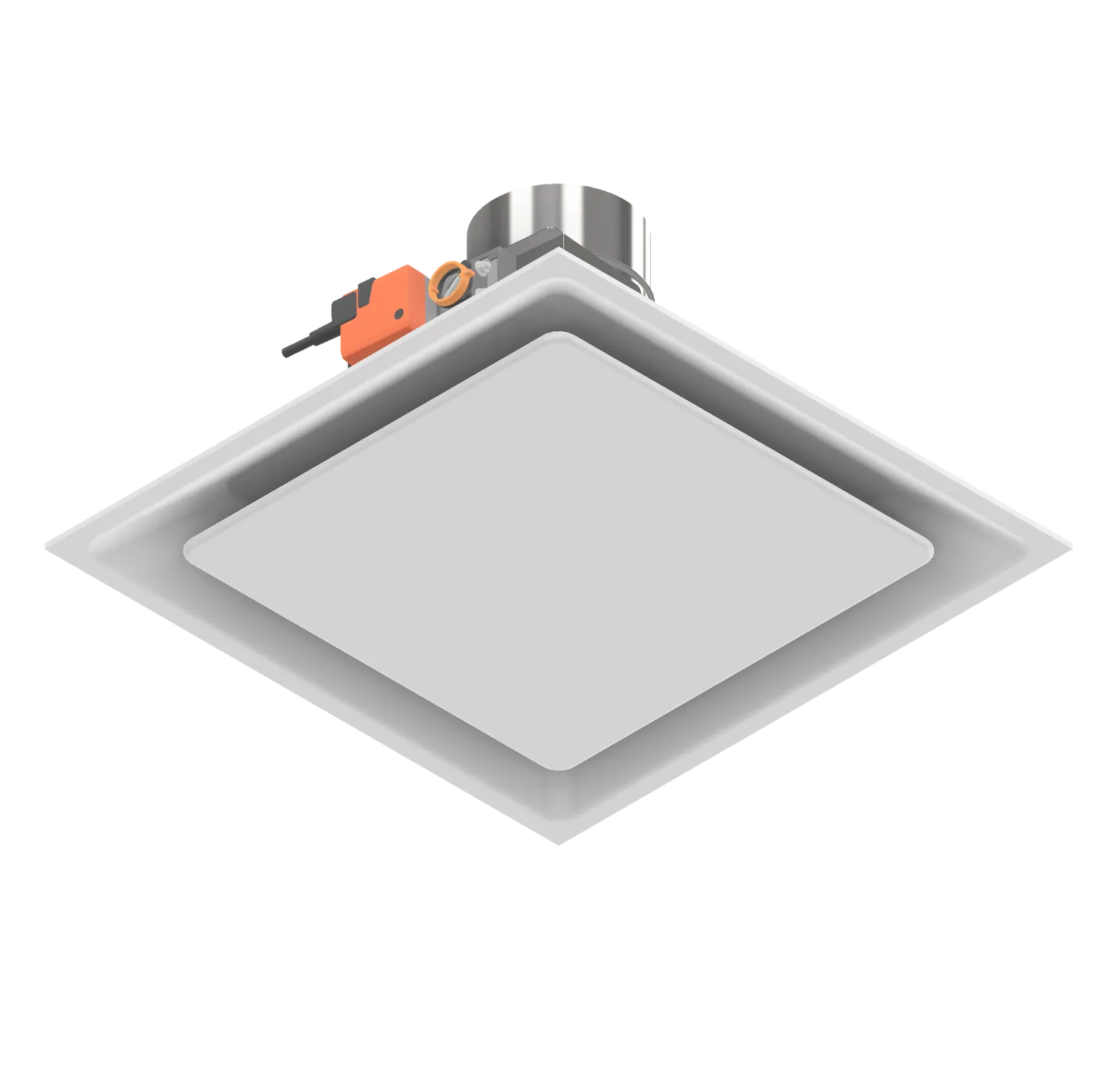
This is a very common type of air outlet, usually seen as a 600x600 mm square panel mounted in a suspended ceiling (matching the size of a standard ceiling tile). Square diffusers come in many styles: the multi-directional louvered-face type, the concave cone-face type (cone diffuser), or the perforated flat-face type (perforated diffuser). What they have in common is that they distribute air in a 360° radial pattern or in 4 perpendicular directions. The most common type is the 4-way diffuser: the discharged air spreads evenly in all four directions around the outlet, travels along the ceiling and only then slowly drops. This discharge pattern helps cover a wide area, and occupants feel little direct draft. Common square diffuser sizes include 300x300, 375x375, 450x450, 600x600 (mm) (Air Distribution Systems Diffuser Selection | PDF | Duct (Flow) | Applied And Interdisciplinary Physics). The airflow handled is usually moderate – a 600x600 square diffuser can supply about 200–500 m³/h depending on the model, suitable for small to medium-sized rooms. For large rooms, several square diffusers are distributed evenly.
Construction: Square diffusers are usually made of steel or aluminum. The louvered-face type has fixed directional vanes inclined at ~45°, arranged in tiers from the inside out to direct the air outward in several different directions (Classification of Starduct air outlets (grilles).). The cone-face (multi-cone) type has 2-3 concentric cone layers; the perforated type has an evenly perforated face plate with directional vanes behind it (e.g. a 4-way star pattern). Some designs have a removable center core for cleaning or for adjusting the internal damper. Square diffusers can be fitted with a plenum box (to reduce noise and balance pressure), especially when connected to round ducts.
Adjustability: Most square diffusers do not allow manual direction adjustment (the vanes are usually fixed). However, there are variants such as 3-way and 2-way adjustable types (with some sides blanked off to change the discharge direction, used for installation next to walls) or even models with automatic airflow-adjusting vanes. In general, square diffusers are designed to perform optimally in their standard configuration, with little user intervention needed.
Performance and noise level: Square diffusers provide a radial airflow with a fairly good induction ratio, creating stable air mixing in the occupied zone. However, their induction is lower than that of slot or swirl diffusers; at very low airflow, cold air may drop directly below the outlet (dumping) (Selecting Air Diffusers - Verasys - LIT-12012331 - General System Information - Verasys System - 4.0), causing discomfort to people underneath. Therefore, square diffusers are better suited to constant air volume (CAV) systems or to VAV systems with a sufficiently high minimum airflow. In terms of noise, most commonly sized square diffusers can operate at NC < 35 under design conditions, corresponding to an open-plan office or retail environment (Titus Engineering Corner: Diffuser Sound - Part I / Making the Best Selection for Your Occupant Space). For quieter conditions (NC30 for meeting rooms, classrooms), a larger size or a greater number of diffusers should be used so that each one runs at a lower airflow. One advantage is that distributing the air through many square diffusers reduces the overall noise compared with a few large outlets (Selecting Air Diffusers - Verasys - LIT-12012331 - General System Information - Verasys System - 4.0).
Applications: Square diffusers are widely used in commercial and office buildings. They are easy to install in a lay-in ceiling grid and give an even air spread, suitable for grid layouts that cover the entire space. For example, in open-plan offices, stores, classrooms and hospitals, square diffusers are commonly seen evenly spaced every 9-16 m² of ceiling. This type also appears in low-ceiling factories or plant areas because it is economical and durable. For cleanrooms or operating theatres, a variant such as a square HEPA filter diffuser or a unidirectional downflow diffuser is used to ensure unidirectional airflow, but those are specialized applications. In short, the square diffuser is a versatile, cost-effective choice for many projects, unless there are special aesthetic or technical requirements.
Round Diffuser
As the name suggests, these are circular air outlets. Round diffusers can be ceiling-mounted (uniform 360°) or duct-mounted (a round outlet fitted to the side of a round duct). Many round variants are in fact "round versions" of square diffusers: for example, the multi-ring concentric type (concentric circular diffuser), similar to the square cone diffuser, or the swirl type (swirl diffuser) with curved vanes that create a swirling flow. Round diffuser diameters vary widely, typically from a small 150 mm (6 inch) to a very large 900 mm (36 inch) (Air Distribution Systems Diffuser Selection | PDF | Duct (Flow) | Applied And Interdisciplinary Physics). Round diffusers usually handle a larger airflow than square ones of the same area, since the circular shape distributes air evenly with few dead corners (Air Distribution Systems Diffuser Selection | PDF | Duct (Flow) | Applied And Interdisciplinary Physics). Many round diffuser models also incorporate directional vanes (e.g. blades that adjust the swirl jets or change the discharge angle) to optimize the throw (Air Distribution Systems Diffuser Selection | PDF | Duct (Flow) | Applied And Interdisciplinary Physics).
Airflow characteristics: Like square diffusers, round diffusers provide a 360° radial airflow when installed on their own in the ceiling. Some duct-mounted round types can be designed for one-way discharge (e.g. a round outlet on the side of a duct with directional vanes like a grille). But the term round diffuser usually refers to the multi-directional discharge type. An important variant is the swirl diffuser: it has angled vanes or spiral slots that make the air rotate as it passes through, so it clings to the ceiling very well and rapidly induces room air (high induction) (Swirl diffusers | TROX Malaysia Sdn Bhd.) (Swirl diffusers | TROX Malaysia Sdn Bhd.). This round swirl type is often used for high ceilings or where large airflows are required.
Supply/return capability: Round diffusers are usually used as supply outlets. Round return outlets can be found (such as round eggcrate or round perforated grilles), but they are less common than round supply diffusers. With round types that have adjustable vanes (e.g. some models with rotatable vanes), the discharge pattern can be adjusted: horizontal along the ceiling for cooling and straight down for heating, to avoid heat accumulating at the ceiling. Some high-end round diffusers have an automatic mechanism (thermal or electric) to switch the air direction between winter and summer modes.
Applications: Round diffusers are favored in high-ceiling or large open spaces, such as shopping mall atriums, railway stations, airports and sports halls, because they can handle large airflows and spread the air evenly. They are also common in offices with exposed ceilings (open ceiling) – round diffusers mounted directly on round ducts provide both an industrial aesthetic and effective air distribution. In factories, round diffusers (multi-ring or swirl types) can be installed alternately with the ceiling lights to ventilate the production area evenly. A special use case is cleanrooms/hospital corridors: round filter diffusers are often used to supply clean air downward (the round shape helps keep the airflow even around the filter area).
Noise level and effectiveness: Large round diffusers can operate effectively at high airflows while still maintaining an acceptable noise level. With large diameters (600-900mm), the airflow per outlet can reach thousands of m³/h. However, note that if an outlet that is too large is used with a low ceiling, the strong airflow may cause discomfort to people directly beneath it. In that case, the airflow should be split among more outlets. For swirl diffusers, the advantage is a very high capacity to induce room air, which quickly eliminates temperature differences and effectively reduces temperature stratification (often used for ceilings higher than 3.5m) (Swirl diffusers | TROX Malaysia Sdn Bhd.). Tests show that swirl diffusers (round or square) can allow a higher room air change rate before causing discomfort, thanks to good air mixing ([PDF] Quick Selection - TROX). In terms of noise, thanks to good aerodynamic design, many large swirl models still have low NC levels even at high airflow – suitable for spaces such as offices and large lobbies.
Jet Nozzle Diffuser
This is a round, nozzle-shaped air outlet capable of throwing air over a long distance at high velocity. Jet nozzle diffusers are usually seen as a short round tube with a flared mouth, mounted on a wall or duct, possibly with a decorative trim ring. Another variant is the multi-jet diffuser, consisting of many small nozzles arranged on a panel. The material is usually powder-coated aluminum or steel.
Airflow characteristics: Jet nozzles produce a concentrated air jet with a throw far exceeding that of conventional diffusers. For example, a 200mm jet nozzle can throw 10-15 m; larger or multi-jet types can reach 20-30 m. Throw values are usually given by manufacturers at a terminal velocity of 0.25 m/s (T50) or 0.5 m/s (T100). Many jet nozzle models have an optimized aerodynamic design to reduce noise and maintain a long throw even at high discharge velocities (jet ring air diffuser grilles jet nozzle diffuser - Coowor.com) (jet ring air diffuser grilles jet nozzle diffuser - Coowor.com). One example: a ball jet diffuser (spherical outlet) with a diameter of 315mm can supply 1000 m³/h with low noise and a throw of more than 20 m (SPHERICAL LONG-THROW DIFFUSER).
Adjustability: Most jet nozzles allow the jet direction to be swiveled within a limit. Typically, the ball-type or swivel-joint construction allows an angle adjustment of +/-30° in all directions (DKOA Jet Nozzle Diffuser | Woods Air Movement). As a result, the jet can be directed upward, downward or to either side as required. Some models incorporate a servo motor to adjust the discharge direction remotely (used in theatres and conference rooms to change with the operating mode). Multi-jet diffusers allow each nozzle to be adjusted individually or are fixed, depending on the design. When a concentrated jet is not needed, some types can be adjusted to disperse the jet (some nozzles have internal vanes to widen the spread angle when air needs to be distributed at short range).
Applications: Jet nozzle diffusers are used in very large or special spaces where a long air throw is needed. Typical examples: sports halls, aircraft hangars, high-bay factories, airport terminals, theatres, large auditoriums – where the ceiling is very high or air must be delivered from a distance to the occupied zone. They are also used in large hotel lobbies or shopping malls near domed roofs, where ordinary diffusers do not have enough reach. For cinemas and theatres, special nozzles (with a rear-facing flared mouth) are used to throw air a long way while remaining quiet, avoiding noise that would affect the acoustics. According to the manufacturer, aerodynamically well-designed nozzles can achieve very low noise levels, suitable even for theatres and studios (DKOA Jet Nozzle Diffuser | Woods Air Movement). In addition, indoor swimming pools also often use this type to blow warm, dry air from a distance to prevent condensation.
Advantages and disadvantages: The outstanding advantage is the long reach and clearly defined direction. Thanks to the strong jet, it also produces high induction, entraining a large amount of room air into the stream and helping the air mix well (even though the initial zone is concentrated). By the time it reaches distant areas, the velocity has dropped and the jet has spread out, ensuring air exchange. The disadvantage is the narrow coverage – each nozzle covers only the area along the jet axis, so to cover the whole room evenly, many units are still needed or they must be combined with other diffuser types. In terms of noise, nozzles may whistle if operated at too high a velocity, but as mentioned, good designs can keep the noise low even at high velocity (DKOA Jet Nozzle Diffuser | Woods Air Movement). Of course, they usually cost much more than conventional diffusers, so they are generally used only when necessary.
Spot Diffuser (Small Spot/Jet Diffuser)
Spot diffusers here refer to small localized directional outlets, such as ball diffusers or small jet outlets serving a specific area. They can be regarded as "small versions" of the jet nozzle and are usually installed in clusters or interspersed among the ceiling panels. For example: ball diffusers that swivel in all directions (usually 100–250mm in diameter) allow the jet to be directed at any angle by rotating the ball within its retaining frame (SPHERICAL LONG-THROW DIFFUSER). This type usually supplies a moderate airflow (a few hundred m³/h each) with a throw of about 5–15 m depending on the size (SPHERICAL LONG-THROW DIFFUSER). They create a concentrated airflow aimed at the required "spot" – hence the name spot diffuser.
Construction: Most are made of thick aluminum to hold the ball or small tube shape. The ball outlet consists of a swiveling ball joint inside a flange. Small nozzle outlets can have directional vanes similar to the large type. A single panel can carry many spot nozzles – for example, the KOO model has up to 10 small nozzles on a 600x600mm panel, handling a large airflow with many evenly dispersed jets (New Product: KOO Adjustable Long Throw Multi-Jet Nozzle Diffusers | EffectiV HVAC) (New Product: KOO Adjustable Long Throw Multi-Jet Nozzle Diffusers | EffectiV HVAC). The small jets combined produce high induction, minimizing thermal stratification while remaining very quiet because the flow is split up (New Product: KOO Adjustable Long Throw Multi-Jet Nozzle Diffusers | EffectiV HVAC).
Applications: Spot diffusers are suitable for offices, large meeting rooms, banks and lobbies – where the project owner wants equipment that is compact yet effective. For example, in a high-ceiling office, instead of using large square diffusers, the architect can choose a few clusters of small multi-nozzle panels arranged aesthetically. They are also useful in rooms that must be quiet: many small jets distribute air more quietly than one large jet (similar to the principle of using multiple diffusers to reduce noise) (Selecting Air Diffusers - Verasys - LIT-12012331 - General System Information - Verasys System - 4.0). In addition, for cold stores or rooms requiring precise air jets (such as blowing onto equipment or onto high-heat zones), spot diffusers allow that zone to be "targeted" precisely. Some high-end offices use controllable spot diffusers (adjusting the air direction at each workstation for staff, increasing personalized comfort).
Comparison with large jet nozzles: Spot diffusers have a narrower coverage and lower capacity, but can be flexibly arranged in clusters. Large jet nozzles are usually seen individually on walls, throwing air tens of meters, whereas spot outlets are usually mounted in numbers on the ceiling to cover the whole room. In terms of cost, the spot type can be expensive if many are used, but in return it offers high aesthetics and comfort. Note that, due to their small size, they need more frequent cleaning and maintenance (small outlets easily collect dust, which reduces airflow) – which is why many models are designed to be easily removed for cleaning.
Applications of Air Outlet Types in Real Spaces
Each type of air outlet has its own advantages and suits different spaces and purposes. Below are some typical examples of air outlet selection by building type and room space:
- Hotel rooms, high-end apartments: Priority is given to low noise and high aesthetics. Slot diffusers are commonly used along the entry corridor or in the room ceiling to distribute air gently and avoid blowing directly onto the bed. Single or double deflection grilles mounted high on the wall can also be used, adjusted to keep the airflow from falling onto the bed. The paint color usually blends in with the ceiling (white or according to the interior design). In this space, the required noise level is about NC25–30 (Titus Engineering Corner: Diffuser Sound - Part I / Making the Best Selection for Your Occupant Space), so large air outlets, or several outlets sharing the airflow, should be selected. Linear bar grilles also appear in modern hotel rooms, concealed in a ceiling slot next to the curtains.
- Meeting rooms, small theatres, cinemas: Quiet conditions (NC25–30) and even air distribution are required so that every seat is comfortable. Large multi-directional square diffusers with sound-attenuating plenum boxes, or round swirl diffusers, are commonly used to mix the air quickly and evenly, avoiding overly cold/hot zones. The air outlets can be placed in the ceiling above the audience area, blowing horizontally to avoid blowing directly down onto people's heads. Sometimes quiet-type jet nozzles are also used in theatres to blow air out from the rear wall, because of their quiet, long-throw characteristics (DKOA Jet Nozzle Diffuser | Woods Air Movement). In high-end meeting rooms, slot diffusers running around the ceiling are an aesthetic and quiet solution.
- Offices (especially open-plan offices requiring quiet): The criteria are low noise (NC ≤ 40 for open-plan offices, NC ≤ 35 for private offices) (Titus Engineering Corner: Diffuser Sound - Part I / Making the Best Selection for Your Occupant Space) and air distribution that avoids direct drafts. 4-way square diffusers are common in open-plan offices because they integrate with the lay-in ceiling and distribute air fairly evenly. However, in high-end offices the trend is to use slot diffusers for their aesthetics and good controllability with VAV. In creative workspaces, exposed round diffusers are sometimes used, serving as both decoration and air supply. To keep the space quiet, diffusers should be oversized (e.g. using 4 square diffusers instead of 3 for the same airflow) so that each one runs more quietly (Selecting Air Diffusers - Verasys - LIT-12012331 - General System Information - Verasys System - 4.0). Offices with low ceilings should avoid strong jet-type outlets that cause discomfort – evenly spreading types should be used.
- Shopping malls, large lobbies: These are high-ceiling, large-area spaces with heavy foot traffic. They require wide-coverage air distribution and may need large airflows due to high cooling loads. Large round swirl diffusers are very suitable here: they can be mounted high, spread the air widely and mix it quickly. Jet nozzles can also be added in specific areas (e.g. entrances or multi-story atriums) to prevent thermal losses and bring the cool air down. In lobbies, the architecture usually emphasizes aesthetics, so air outlets can be painted in matching colors or cleverly concealed (e.g. placed high on walls behind decorative louvers). The noise level for public spaces such as lobbies can be higher (NC40-45) (Titus Engineering Corner: Diffuser Sound - Part I / Making the Best Selection for Your Occupant Space), so air outlets that run slightly noisier than in offices may be acceptable, but concentrated airflows that produce a clearly noticeable whistle should still be avoided.
- High-bay factories and warehouses: Priority is given to air distribution effectiveness and durability, while aesthetics are less important. Large jet nozzles mounted high on walls or columns are commonly used to blow cool air down to the work areas below. Industrial round swirl diffusers (600-800mm) can also be suspended from the ceiling, if there is one. Some factories choose perforated fabric ducts running along the building for even distribution – effectively a form of linear diffuser. Since machinery noise in a factory environment is already high, noise levels of NC45+ may be acceptable, but strong direct blowing on workers should still be avoided. Metal air outlets in factories need a good protective coating or should be made of aluminum/stainless steel to withstand the environment (e.g. chemical fumes, high humidity).
- Special spaces (cleanrooms, laboratories, hospitals): These spaces have their own requirements: cleanrooms need HEPA filter diffusers, usually of the perforated or short-slot type, delivering a unidirectional downward airflow; laboratories usually use round/square diffusers with filter screens, or the slot type if flow control is needed. Hospitals (operating theatres) use multi-layer membrane downflow outlets to create unidirectional flow; patient rooms use 4-way diffusers but with a low-noise requirement (NC30) so that patients can rest. These applications are beyond the scope of this document, but should be noted if encountered: specialist standards (ASHRAE, CDC, USP...) and the guidance of specialist manufacturers should be consulted.
In short, air outlet selection must carefully weigh the features of the device against the specific requirements of the space. No single type suits every situation; usually several types need to be combined in one building: for example, a shopping mall may use square diffusers for small shops, round swirl diffusers for the large lobbies, bar louvers for the corridors and nozzles for the atrium. Engineers need to work with architects and project owners to arrive at a coordinated solution that is both technically sound and aesthetic.
Air Outlet Selection Criteria (Grille/Diffuser)
When deciding which type of air outlet to use on a project, engineers need to weigh many factors. Below are the main criteria and guidance on evaluating them:
- Function and air distribution needs: Determine whether the function of the air outlet is supply or return air. Supply outlets need a type that distributes air well, with suitable directional adjustment; for return outlets, attention should be paid to a large free area and low resistance (egg-crate or simple fixed-blade grilles are commonly used). Next, determine the distribution objective: large rooms need outlets that spread the air in many directions, while narrow rooms can use directional types. If a long air throw is required (e.g. large lobbies, factories), jet nozzles or swirl diffusers should be considered instead of conventional diffusers. Conversely, small spaces may need only a simple grille. Also consider the system type: for variable air volume (VAV) systems, prefer diffusers that perform well at low airflow (such as slot, swirl) (Selecting Air Diffusers - Verasys - LIT-12012331 - General System Information - Verasys System - 4.0); for CAV systems with little variation, standard types also perform well.
- Architecture and aesthetics: The air outlet is the part that is visible in the interior space, so its form and location affect the aesthetics. If the architecture requires concealment, a linear slot diffuser integrated with the ceiling lines can be chosen, or a grille painted the same color as the ceiling. If a modern look is emphasized, round diffusers can be left exposed or decorative air outlets (with decorative patterns or special colors) can be used (Classification of Starduct air outlets (grilles).). Work with the architect early to agree on the type of air outlet and its layout: for example, slot diffusers suit a minimalist architectural style very well, whereas in an industrial style round nozzles can be left exposed. Air outlet size must also be in proportion to the space (an outlet that is too large in a small room looks bulky, while one that is too small in a large room is ineffective and looks out of proportion). Sometimes a little technical performance is traded off for aesthetics (e.g. hiding the air outlet behind a decorative slot) – in that case this must be compensated for by increasing the number or size of the air outlets to ensure functionality.
- Noise level (acoustic requirements): Each space has a different permissible HVAC noise level (according to standards or the project owner's wishes). Engineers need to select air outlets with suitable acoustic characteristics by checking the manufacturer's NC charts. The rule is that the air outlet should have an NC about 5-10 points lower than the room's target NC (Titus Engineering Corner: Diffuser Sound - Part I / Making the Best Selection for Your Occupant Space), so that the requirement is still met when it combines with other sources. For example: for a hotel bedroom with a target of NC30, choose diffusers with NC ≤ 20 at the design airflow. If the proposed air outlet is too noisy, increase its size or the number of outlets to reduce the load on each one (Selecting Air Diffusers - Verasys - LIT-12012331 - General System Information - Verasys System - 4.0). Also pay attention to the installation configuration: an air outlet connected directly to a duct neck with a damper immediately behind the neck is usually noisier than one connected through a sound-attenuating plenum box. Avoid forcing air through narrow slots at high velocity, which causes whistling – if the aesthetics of a narrow slot are required but the airflow is large, divide it into several slots or increase the slot length. In special spaces such as studios and recording rooms (requiring NC < 20), it may be necessary to use special acoustic diffusers or a layout such as displacement ventilation (supplying air very slowly through large outlets at floor level).
- Distribution performance and coverage: This criterion evaluates whether the air outlet delivers air to every place it is needed and whether it avoids phenomena such as thermal stratification and dead air zones. Swirl or slot type outlets are highly effective at mixing air, so they suit high ceilings, where they reduce stratification. Conversely, the plaque type provides a very gentle airflow but low induction, and should only be used with low ceilings in small rooms. Engineers need to check the throw of the diffuser to see whether it reaches the farthest area. If one diffuser does not have enough reach to cover the room, the number may need to be increased or a longer-throw type chosen. The Coanda effect should also be considered: many diffusers need a ceiling above for the airflow to attach to; if one is suspended in the middle of the space (free jet), its coverage is reduced by ~30% (Air Distribution Systems Diffuser Selection | PDF | Duct (Flow) | Applied And Interdisciplinary Physics). In long rooms, air outlets along the length of the room may be needed instead of just a few at one end. The goal is to achieve a uniform temperature distribution, with small differences within the occupied zone (usually <1-2°C). To achieve this, it is sometimes necessary to combine diffusion types (for evenness) with some jet types (for reach) in the same space.
- Ease of maintenance: Air outlets will need periodic cleaning because dust and dirt accumulate from the airflow. Some designs allow easy removal (e.g. removable-core grilles with spring-release catches (Classification of Starduct air outlets (grilles).) for wiping or for removing the dust filter inside). For return grilles with filters, a type that opens conveniently is needed. This criterion is especially important in dusty environments or those requiring a high level of cleanliness (hospitals, cleanrooms). If a slot diffuser is too small to be cleaned inside, black dust may build up on the ceiling, spoiling its appearance and obstructing the airflow. Therefore, choose a size large enough to be easy to clean, or a type with a removable core (like the many square diffusers whose center core can be taken down for cleaning). Materials also affect maintenance: ABS plastic may discolor or crack over time with cleaning, whereas aluminum and well-coated steel withstand repeated cleaning better. In chemical or corrosive environments, stainless steel should be considered for durability and so that cleaning with strong solutions does no damage.
- Material durability and finish quality: Air outlets are usually made of extruded aluminum, galvanized steel or plastic. Each material has its pros and cons: aluminum is light, rust-resistant and suitable for most applications; steel is cheaper but needs a good anti-rust coating (high humidity can cause hidden rust under the paint if the coating is poor); ABS plastic is used for small round diffusers or grilles to avoid condensation (such as in cold rooms), but plastic can age. The quality of the finish is also very important: choose products with powder coating in standard RAL 9010 (white) or an optional color from a reputable brand, e.g. Jotun, to ensure colorfastness for at least 5 years without yellowing or peeling (DOUBLE DEFLECTION OVAL BLADE AIR GRILLE, FIXED/REMOVABLE CORE). For exterior locations (such as outdoor louvers), outdoor-grade paint or anodized aluminum is recommended for weather resistance. Mechanical durability: air outlets installed where impacts are likely (low down near the floor, industrial areas) need a sturdy construction, with blades that are not so thin that they dent easily. In practice, there are many cases of air outlets damaged by impact or by repeated removal – so if the area is at risk, choose a type with a thick frame and firmly fixed blades rather than an elaborate one. If outdoor use is needed (fresh air intake, exhaust air discharge), weather louvers or sand trap louvers must be used instead of conventional diffusers, and the material should be aluminum or stainless steel.
- Cost and budget: Finally, cost is a criterion that cannot be ignored. Some premium air outlet types (linear slot, swirl, jet nozzle) can cost many times more than standard types (fixed-blade grilles, steel square diffusers). Engineers need to work with the project owner to prioritize the budget for the spaces where it is needed. For example, the reception lobby may justify spending on an aesthetic linear slot, while ancillary rooms use cheaper grilles. Also account for ancillary costs: slot diffusers need additional plenum boxes with good acoustic treatment, large nozzles sometimes need reinforced suspension structures, etc. If the budget is limited, a middle-ground solution can be chosen: for example, instead of using expensive slot diffusers throughout, ordinary square diffusers painted the same color as the ceiling can be used to "hide" them somewhat – saving money while still ensuring functionality. Besides the purchase price, also consider operating costs: a good diffuser that distributes air evenly can help save energy by avoiding overly cold/hot areas, so that users do not need to set the temperature too low/high to compensate. This is also a long-term benefit of investing in the right type of air outlet.
In short, air outlet selection is a multi-criteria problem. Engineers must balance technical effectiveness against aesthetic wishes, and performance against cost. The following comparison table summarizes the main characteristics of common air outlet types and can be used as a quick reference during design.
Comparison of Common Air Outlet Types
The table below compares the air outlet types discussed above against several key criteria:
| Air outlet type | Airflow characteristics | Typical applications | Aesthetics | Durability | Cost |
| Linear Bar Grille | Straight/slightly angled discharge, long spread, supply or return | Offices, lobbies, hotels, corridors | High | High | Medium - high |
| Single deflection grille | One-way discharge (up/down or left/right) | Hotel rooms, small meeting rooms, offices | Medium | High | Low - medium |
| Double deflection grille | Multi-directional discharge, flexible adjustment | Large rooms, halls, lobbies | Medium | High | Medium |
| Slot Diffuser | Discharge along the ceiling, high induction, effective at low airflow | High-end offices, corridors, showrooms | Very high | High | High |
| Square diffuser (4-way) | 4-way discharge spreading along the ceiling | Offices, stores, classrooms | Fairly high | Medium | Low |
| Round diffuser (360°) | Radial discharge, swirl or even spread | Lobbies, factories, open-ceiling offices | Medium | High | Medium |
| Jet Nozzle | Strong jet, long throw, ±30° adjustment | Factories, theatres, large lobbies | Low | High | Very high |
| Spot diffuser (Spot/Ball Jet) | Localized jet, medium throw | Offices, meeting rooms, lobbies, personalized comfort | High | High | High |
(Note: The table above is indicative only; each type of air outlet comes in many specific models with different performance. Refer to the manufacturer's catalogue for detailed data before designing.)
Looking at the table, it can be seen that linear bar grilles and square diffusers are general-purpose solutions, balanced in both cost and performance, while slot diffusers and nozzles are geared toward cases with special requirements (high aesthetics or long throw). Adjustable grilles (single/double deflection) play an important role in "fine-tuning" the airflow and are not too expensive, so they are widely used in standard buildings. In actual design, types can be combined: for example, a large room may use square diffusers in the center and adjustable grilles at the perimeter to ensure full coverage of the zone.
Aesthetic Impact and Finish Quality
Air outlets are not merely technical devices but also a component of the interior ceiling/walls. Therefore, aesthetics and surface finish deserve close attention:
- Color and surface finish: The standard color of most air outlets is off-white (RAL 9010) – matching the common white ceiling. The coating is usually powder coating, with good adhesion and a smooth surface. The project owner may request a custom paint color to suit the design (e.g. matte black for a black theatre-style ceiling, or the same color as the wall for wall-mounted outlets) (DOUBLE DEFLECTION OVAL BLADE AIR GRILLE, FIXED/REMOVABLE CORE). Paint quality has a major effect on long-term aesthetics: poor paint may yellow, peel or fade after 1-2 years. Therefore, reputable paint brands (Jotun, AkzoNobel...) and standard powder coating technology should be used, ensuring adhesion and colorfastness for more than 5 years (DOUBLE DEFLECTION OVAL BLADE AIR GRILLE, FIXED/REMOVABLE CORE). Some aluminum air outlets also have a matte aluminum anodized option, giving a modern look and good scratch resistance. In harsh environments (outdoors, chemicals), fluoropolymer paint or thick anodizing is recommended to maintain the appearance.
- Style: Depending on the interior design, air outlets can be made to stand out or be concealed. To conceal them, solutions such as linear slots, grilles hidden within decorative slats, or a flat-face type with no visible blades can be used (e.g. a plaque diffuser with a detached flat face and only a gap around the edge, which looks like an ordinary ceiling panel). To make them a feature, decorative air outlets can be chosen: for example, some manufacturers offer air outlets with artistic patterns, metal plating, wood grain, etc., suited to classic or luxurious styles (Classification of Starduct air outlets (grilles).). These air outlets meet the technical requirements while also forming part of the decorative ceiling.
- Coordination with the ceiling/wall architecture: Many high-end projects have flat ceilings rather than lay-in grid ceilings, in which case the air outlet positions need to be planned harmoniously: they can be placed in stepped ceilings, light coves, curtain pockets... to avoid breaking up the ceiling layout. For example, placing a linear diffuser along the curtain pocket in a hotel room both conceals the air outlet and creates an air curtain that blocks heat at the glazing. Translucent ceilings can also conceal perforated outlets above them, creating a gentle airflow with no visible source. The border size also needs attention: a border that is too wide is very noticeable on a flat ceiling (in this case, a borderless or thin-border type looks better).
- Finishing installation details: For a good appearance, the air outlets must be installed carefully. Gaps around the air outlet must be sealed, and the gypsum board cut-outs must be neat and fit the outlet frame. If the air outlet has exposed screws, they should be painted the same color and aligned neatly. Many diffusers today use concealed spring clips instead of screws for a clean surface. Also note the need to clean the air outlets before handover: white paint gets dirty very easily during construction and must be wiped clean so as not to spoil the appearance.
- Coordination with other equipment: The ceiling also carries lights, speakers, fire detectors... Air outlets should be arranged in balance with the other devices, avoiding spots crowded with equipment that look cluttered. Usually, the architect provides a ceiling plan (RCP – Reflected Ceiling Plan), on which the engineer bases a sensible air outlet layout. Where possible, align the edges of the air outlets with the edges of the lights or the ceiling grid for a neat look.
In short, in terms of aesthetics and finish, the key is close coordination between architecture and MEP. A good HVAC design does not just provide cooling and ventilation; it must also be "invisible" to occupants or even contribute to the beauty of the space. This requires selecting suitable equipment from the outset and taking care over the finishing.
Conclusions and Design Recommendations
Selecting air outlets (air grilles/diffusers) for an HVAC system is a process that requires an in-depth understanding of both the technical aspects and the usage requirements of the space. This document has presented the common types of air outlets, their characteristics and applications, as well as criteria and comparisons to support the selection decision. Below are some key recommendations drawn from the above analysis:
- Carefully assess the needs of each space: Each room and space in a building has different requirements for airflow, distribution pattern and noise level. Engineers should work with the architect/project owner from an early stage to understand the priorities for each space (quiet, aesthetics, or simply an economical solution). This helps in choosing the right type of air outlet from the start and avoids changes once construction is underway.
- Combine several types of air outlet when needed: It is not necessary to use a single type throughout the building. Combine the advantages of the different types – for example: use slot diffusers for luxurious lobbies, square diffusers for standard office areas, adjustable grilles for corridors, nozzles for high-ceiling factories. This combination should be accompanied by consistency in color and style so that the whole does not look disjointed.
- Optimize quantity and positions to reduce noise and improve air evenness: Instead of forcing the airflow through a few large outlets, consider splitting it across more outlets to achieve even coverage and reduce velocity, thereby reducing noise (Selecting Air Diffusers - Verasys - LIT-12012331 - General System Information - Verasys System - 4.0). This is especially important for rooms that must be quiet. However, also avoid overdoing it, which leads to high costs and aesthetic complexity – a balance must be struck. Air distribution simulation software (CFD) or throw and induction calculations can help determine the optimal positions, especially in complex spaces.
- Always check manufacturer data: Every air outlet model has a technical data catalogue: airflow range, throw at different air velocities, pressure drop, NC… Engineers must consult it to ensure they select the right size to meet the required airflow without excessive noise or insufficient throw. For example, if the distance from the air outlet to the farthest area is 8m, make sure the diffuser has a T0.25 throw of at least 8m at the design airflow. If the diffuser under consideration does not achieve this, consider increasing the size or changing the type (e.g. from an ordinary square diffuser to a swirl diffuser).
- Pay attention to actual installation conditions: The real-world performance of air outlets depends on the installation conditions: duct connection type, whether there is a plenum box, ceiling height, surrounding obstructions... Follow the manufacturer's installation recommendations (minimum distance to the ceiling and to walls, minimum straight duct length before the diffuser for uniform flow, etc.). For example, a slot diffuser needs a correctly designed plenum box to distribute air evenly along its full length; a jet nozzle mounted on a curved surface may have its adjustment angle affected… Understanding these points helps avoid mistakes that reduce effectiveness.
- Plan for long-term maintenance: In the design, ceiling access panels should be provided near air outlets that have dampers or sensors inside requiring adjustment. Choose air outlet types that local maintenance staff are familiar with, to ensure they know how to remove and clean them. For specialized imported air outlets, clear instructions and even short training should be provided for the future operations team.
- Weigh cost against effectiveness: The most expensive type is not always the best for every location. Aim for an overall effective solution: ensuring microclimate comfort within the allowable budget. If costs need to be cut, prioritize keeping premium equipment in important areas (lobbies, VIP rooms), while ancillary areas can use standard types. But do not economize so much that the wrong type is used, resulting in poor operation (e.g. using too few diffusers leads to uneven cooling and occupant complaints – and remedial work then costs even more).
- Consult reputable standards and literature: Beyond experience, consult guidance from ASHRAE, HVAC handbooks and manufacturer literature (Price, Trox, Titus, etc.) on air outlet design. For example, the ASHRAE Handbook usually contains tables of diffuser selection criteria by ceiling height and room activity level; or Trox has a detailed catalogue on the application of swirl diffusers in industry (Swirl Diffusers - TROX - PDF Catalogs | Documentation | Brochures)... These documents help to underpin design choices with a scientific and empirical basis.
Finally, occupant satisfaction is the measure of success in air outlet selection. A correct design provides a comfortable environment, with cool/warm air distributed pleasantly, no hot/cold spots or drafts, and no noise – while people entering the room do not even notice the presence of the air outlets, because they have been blended into the architecture. That is the engineer's goal when designing an air distribution system. We hope this "white paper" provides useful knowledge and guidance for achieving that goal in real projects.
References:
- Vairtech Blog: “How does the HVAC diffuser work and how to choose” – discusses the role of diffusers in distributing air evenly (air diffuser,air grille,Hvac system,linear slot diffuser,linear bar grille,square diffuser,ceiling diffuser) (air diffuser,air grille,Hvac system,linear slot diffuser,linear bar grille,square diffuser,ceiling diffuser).
- Johnson Controls (2020): Application Note - Selecting Air Diffusers – recommends slot diffusers for VAV systems because of their high performance at low airflow (Selecting Air Diffusers - Verasys - LIT-12012331 - General System Information - Verasys System - 4.0), with notes on noise levels and diffuser layout (Selecting Air Diffusers - Verasys - LIT-12012331 - General System Information - Verasys System - 4.0).
- Article “Classification of Starduct air outlets (grilles)” – describes fixed linear bar, adjustable blade, square diffuser and slot types of air outlet… (NSCA – 2024) (Classification of Starduct air outlets (grilles).) (Classification of Starduct air outlets (grilles).).
- Starduct catalogue: Technical information on single deflection (SAG) and double deflection (DAG) grilles – A6063-T5 aluminum, free area ~80%, RAL9010 powder coating durable for >5 years (SINGLE DEFLECTION OVAL BLADE AIR GRILLE, FIXED/REMOVABLE CORE) (DOUBLE DEFLECTION OVAL BLADE AIR GRILLE, FIXED/REMOVABLE CORE).
- Titus HVAC Blog (2018): “Diffuser Sound – Making the Best Selection” – acoustic design guidance for diffusers, advising that the diffuser NC be selected 10 lower than the desired room NC (Titus Engineering Corner: Diffuser Sound - Part I / Making the Best Selection for Your Occupant Space) and that diffusers >NC25 be avoided in common spaces (Titus Engineering Corner: Diffuser Sound - Part I / Making the Best Selection for Your Occupant Space).
- Woods Air Movement – DKOA Jet Nozzle product: recommends nozzles for airports, sports halls…, with ±30° angle adjustment and very low sound, suitable even for theatres (DKOA Jet Nozzle Diffuser | Woods Air Movement).
- EffectiV HVAC article (2017): introduces the KOO multi-nozzle diffuser – many small jets providing high induction, reduced stratification and very low noise (New Product: KOO Adjustable Long Throw Multi-Jet Nozzle Diffusers | EffectiV HVAC).
- FK026 spherical diffuser design (Starduct) – throw of up to 20m, multi-directional swivel ball construction in 1.0–1.2mm aluminum, powder coating colorfast for 5 years (SPHERICAL LONG-THROW DIFFUSER) (SPHERICAL LONG-THROW DIFFUSER).
- ASHRAE Handbook and Price, Trox technical literature – guidance on selecting diffusers by ceiling height and airflow, and classification of distribution zones (referenced in the article (Air Distribution Systems Diffuser Selection | PDF | Duct (Flow) | Applied And Interdisciplinary Physics) (Air Distribution Systems Diffuser Selection | PDF | Duct (Flow) | Applied And Interdisciplinary Physics)).
Published by: R&D Department - Star Asia Company