
English version machine-translated from the Vietnamese original — under review.
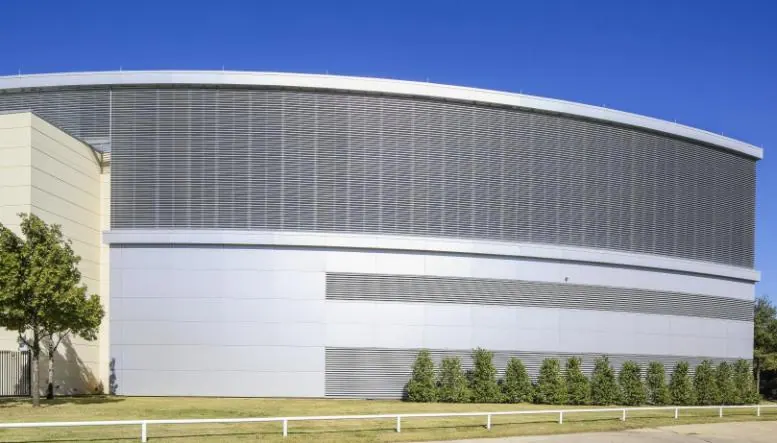
In underground station projects, high-rise buildings or emergency ventilation systems, a louver is not just a “cover” but also a device that protects the system from wind-driven rain and dust and reduces pressure loss. Selecting the right louver directly affects the operating efficiency and durability of the entire system.
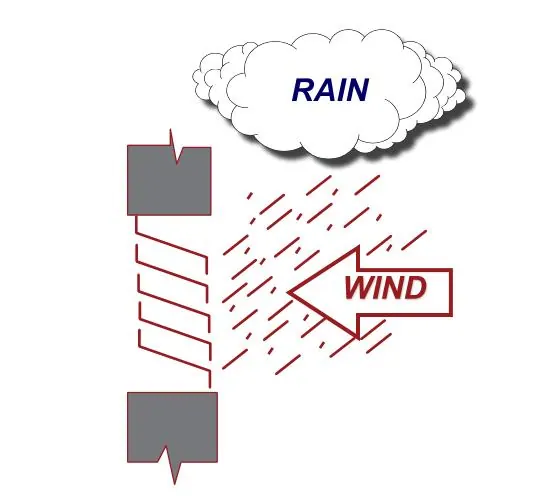
To calculate accurately, engineers need to rely on standardised test data from the manufacturer, certified to AMCA 500-L, EN 13030 or equivalent. The key information the manufacturer must provide includes:
- Rain defence effectiveness and water penetration (in wind-driven rain and still-air rain) at different velocities.
- Pressure loss corresponding to the airflow through the louver.
- Free Area Rate and core ventilation dimensions (Core Area).
- Installation conditions and louver blade geometry.
With all this information, engineers can compare options, calculate water penetration and select a louver type suited to the climate, installation location and operating requirements. Without sufficient data, selection is based only on guesswork – and the risk is very high.
Core standards & criteria
AMCA 500-L / EN 13030: tests for wind-driven rain (WDR) and still-air rain; provide curves/tables:
- Rain defence effectiveness ε = f(V_core) (or EN 13030 class A/B/C/D).
- Water penetration mL/m²·15 min = f(V_FA) (still-air/simulated rain).
- Pressure loss ΔP = f(V_FA) (as K [Pa/(m/s)²] or coefficient ζ).
ISO 15927-3 / BS 8104: method for calculating driving rain on walls for input into design formulas.
Parameters the manufacturer must publish (with AMCA/EN certificates)
- Test specimen size (usually 1200×1200 mm) & area definitions: A_core, A_free and Free Area Rate.
- Velocity limits during testing (applicable V_core, V_FA range) to avoid extrapolation.
- Blade geometry (angle/depth/pitch), material–coating, drainage/drip edge details, installation conditions (flush/recessed in wall/hood).
- ΔP curve and ε(V_core) in both intake/exhaust modes (many different models).
- Certification statement (AMCA CRP/EN Report ID) matching the published curves.
How to use them in calculations
- From Q_air → calculate V_core = Q/A_core, V_FA = Q/A_free.
- Look up ε(V_core), P(V_FA) (mL/m²·15 min).
- Calculate Q_in(WDR) = A_core·I_wall·(1−ε); Q_in(still) = (P/1000)·4·A_ref·(1−ε).
- Check ΔP, and provide a recess/hood if necessary.
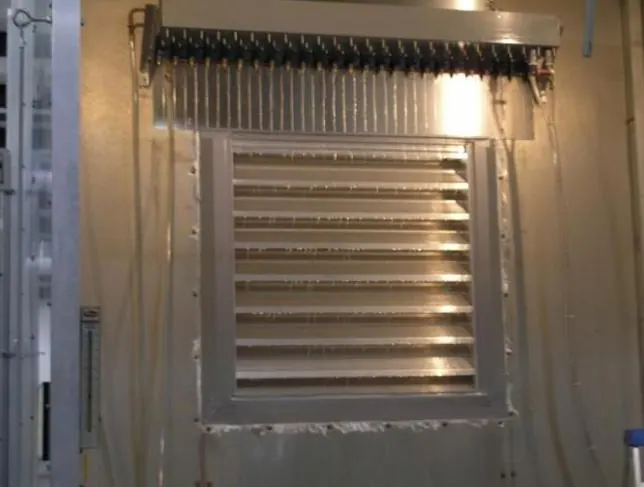
Without data from the manufacturer, or without understanding how rainwater penetrates, engineers can easily misjudge performance, leading to water ingress that damages equipment or increases maintenance costs. Therefore, selecting a suitable louver requires technical expertise + test data + practical experience. This is why HVAC engineers should approach this topic in a systematic and scientific way.