English version machine-translated from the Vietnamese original — under review.
Based on NFPA data tracking in the 1930s, in 1939 the National Board of Fire Underwrites suggested that dampers installed in HVAC systems were for preventing the spread of smoke, fire and heat in fires. Since then, many experts in fire protection science have demonstrated the effectiveness of fire/smoke dampers and automatically closing fans in HVAC systems in confining smoke, fire and heat to the area of origin, preventing them from spreading to adjacent areas of the building. Worldwide, fire protection engineers and mechanical engineers continually integrate fire/smoke dampers into the designs of many modern buildings.
LEGAL REQUIREMENTS A fire damper is a device installed in an HVAC system that closes automatically when it is exposed to a temperature as specified in the UL 555 standard.
A smoke damper is a device installed in an HVAC system to control the movement of smoke in accordance with the UL 555S standard. A combination fire/smoke damper performs the functions of both a fire damper and a smoke damper, and it must meet the test requirements of both types.
In the US, current codes contain provisions requiring buildings to be able to resist the spread of smoke. Some codes require smoke dampers to be installed. The 2000 edition of the International Building Code (IBC) retained the requirement for smoke dampers in fire-rated corridor walls, with the same wording as in earlier codes.
However, in the 2000 edition, the IBC added a new requirement for smoke dampers at penetrations of shaft enclosures in place of the requirement for an engineered smoke control system, which had been mandatory in certain situations in two of the 3 codes. This code change was accepted by the new IBC on the basis that many of the fire and smoke rating requirements for floors and ceilings in earlier codes had been weakened or eliminated when sprinklers were installed.
Because the requirement to install smoke dampers where ductwork penetrates the walls and floors of enclosed shafts is a new requirement, and even though it concerns preventing the spread of smoke within the building, there have been objections at every code revision from 2000 until now. The argument against smoke dampers is based on the idea that installing and maintaining smoke dampers is an "unreasonable" cost for building owners, while it does not increase the safety of the people in the building. The debate broke out again during the hearings on the IBC 2012 code on 18 - 19 May in Dallas.
The reliability and effectiveness of sprinklers are often cited as an argument for removing smoke dampers from shafts. The International Code Council (ICC) has been voting in favour of (siding with) members who firmly oppose the proposal to remove all smoke dampers from shaft penetrations. Although the ICC has voted to support some further studies since the proposal (to install smoke dampers) was approved, smoke dampers are still being applied in many buildings. However, the question of the cost and effectiveness of smoke dampers in sprinklered buildings remains.
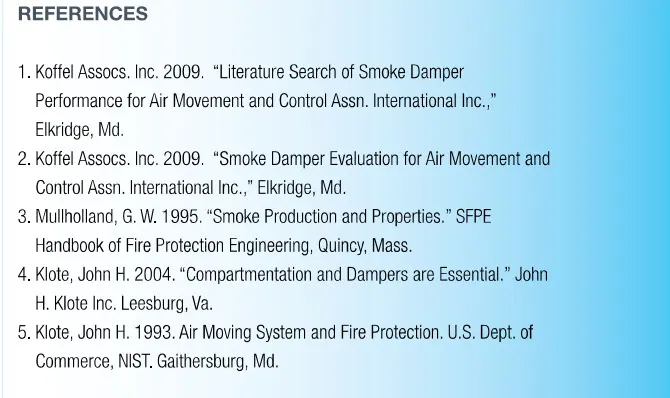
THE AMCA STUDY In 2008, AMCA contracted Kofel Assocs. Inc to conduct a study to shed light on this subject and to serve as a basis for computer modelling. The study produced the following two interesting points:
First, there is no literature supporting the view that smoke dampers should be removed at shaft penetrations. On the contrary, the research literature shows that over the past 25 years, the spread of fire has been a life safety problem. Many fires have occurred in residential occupancies, where some building code requirements did not specifically call for smoke dampers but did require resistance to smoke spread (which could be achieved with smoke dampers). The data obtained show that the fire protection methods of this period did not clearly specify when smoke dampers were not needed, and did not even indicate whether smoke dampers had been installed under the code mentioned above.
Second, the research literature shows a comprehensive modelling and testing effort on the (lateral) spread of smoke through shafts in buildings. Further work on this modelling was contracted to Koffel Assocs. to extend the research in order to show more clearly the benefits of smoke dampers at shaft penetrations in sprinklered buildings. The Koffel Assocs. research and modelling report was nearly complete at the time this article was published and will soon be available on the AMCA website.
THE DEBATE ON SPRINKLER RELIABILITY At the centre of every debate on whether to remove a fire and smoke safety feature to offset the cost of automatic sprinklers lie 2 issues: the reliability of automatic sprinkler systems and their cost-benefit ratio. The fact that sprinkler systems have failed to perform in many cases is not disputed. However, the frequency and causes of sprinkler failures give rise to many conflicting opinions. When the sprinkler system is disabled, a fire can become the source of unforeseeable disasters.
Sprinkler reliability is frequently put forward to promote the view that it is enough simply to install them, without giving much consideration to failure scenarios resulting from the absence of certain features. In 2009, John Hall of the NFPA published the report "U.S. Experience with Sprinklers and Other Automatic Fire Extinguishing Equipment". The fire data were compiled from reports for the period 2003 to 2006. In this study, Hall states that "automatic sprinklers are a highly effective element of the total fire protection design in buildings where sprinklers are present throughout the building area; they actually operated in 95% of fires large enough to activate the system. When activated, they were effective 96% of the time; overall, sprinkler systems operated effectively in 91% of reported fires where sprinklers were present in the fire area and the fire was large enough to activate the system" .
In 1977, an NFPA study examined data from 1986 to 1995 to assess the extent of fire and smoke spread in buildings with and without sprinklers. For high-rise buildings (7 storeys or more), the study showed that 11.4% of fires in sprinklered buildings caused smoke damage beyond the floor of origin. For mid-rise buildings (3 and 6 storeys), 15.7% of fires in sprinklered buildings caused smoke damage beyond the floor of origin, while 34.4% of fires in unsprinklered buildings caused similar damage.
Meanwhile, the studies were unable to show the severity of the damage caused by smoke or toxic gases; that is, many fires in sprinklered buildings caused smoke damage beyond the floor of origin. If smoke dampers are omitted in sprinklered buildings and the automatic sprinkler system fails for any reason, the spread of smoke in fires will certainly increase.
An important point to note is that neither the NFPA reports suggesting that sprinkler systems can suppress smoke nor the reports on fires extinguished by sprinklers show that the sprinklers continue to suppress the smoke being generated. The article by G.W. Mullholland entitled "Smoke Production and Properties", published in 1995 in the Handbook of Fire Protection Engineering, recorded a calculation that if the soot particles produced by an armchair padded with 4kg of polyurethane foam were evenly dispersed in a 150 m2 room, you would not be able to see your hand with your arm stretched out in front of you. Even when sprinklers have extinguished the flames, the fire may still smoulder and produce soot particles and toxic gases.
Many fire investigations have shown that sprinklers were unable to reach the seat of the fire because of obstructions, so that the fire was no different from one without sprinklers.
Experts affirm that automatic sprinkler systems are very effective, although they are not absolute. The sprinkler industry, fire protection services and firefighting communities are constantly striving to improve sprinkler reliability as failures are recorded. John Klote, in an article entitled "Compartmentation and Dampers Are Fundamental", stated that "in a situation where buildings are constantly undergoing changes in required function, materials, construction methods and architectural design, it can be expected that failure scenarios will increase. Therefore, sprinklered buildings need other fire and smoke protection features to ensure the level of protection in the event that the sprinklers fail." In addition, damper manufacturers, contractors, installers and fire protection services are working together to ensure that dampers are installed correctly and reliably inspected on a periodic basis.
Building codes can control the materials used in buildings to suit the sprinkler systems as designed. However, neither building codes nor designers can control the materials of the furnishings in a building. If there are furnishings made of "unsuitable" materials in the building, the sprinkler system may not be able to perform as effectively as intended. Therefore, sprinkler systems need to be supplemented by other designs, systems or devices (such as smoke dampers) to help control smoke even when the sprinklers operate properly and correctly.
CONCLUSION The above are just a few of the arguments about whether HVAC systems can carry smoke away from fire areas. However, there are still many opinions on the optimal method for controlling smoke in both sprinklered and unsprinklered fires. For many years, system shutdown has been the standard approach to smoke control. However, since 2000, smoke control operation of HVAC systems has not been required in most building constructions under the IBC. Without an engineered smoke control system or a shutdown system with dampers in the supply and exhaust shafts, the HVAC system can carry smoke to every place it reaches. Even if the HVAC system is shut down without the corresponding dampers, it cannot prevent additional oxygen from being supplied to the fire and cannot completely stop smoke from circulating in the system. Installing smoke dampers in ducted supply and exhaust shafts can help eliminate the circulation of smoke in the HVAC system.